Who Actually Eats a Damaged Parcel? Three Ways to Carry the Loss, Compared
Carrier declared value, third-party parcel cover and a self-funded reserve settle damage very differently, and packaging evidence decides more claims than the dent does.
| Published | Section | Business & Trade | |
|---|---|---|---|
| Author | Sebastian Kowalczyk | Reading time | 5 min |
A dented corner and a cracked ceramic mug look like a carrier problem. They usually are, in the sense that something in the network dropped the box. But the question that decides who pays is not what happened in transit, it is whether the package was built to survive what a parcel network normally does to a package, and that question gets answered from your side of the file, not the carrier's. Most shippers discover this on their fourth or fifth denied claim, when the pattern stops looking like bad luck.
The assumption: the carrier broke it, so the carrier pays
The widely held belief is that a shipping label buys a promise of safe arrival, and that damage in transit is therefore the carrier's cost by default. What a tariff or service guide actually creates is a limited liability, capped at a modest default amount per shipment unless you declare a higher value, and hedged with exclusions for insufficient packaging, for inherent fragility, and for items the carrier never agreed to accept in the first place. Interstate motor carrier cargo liability sits within a federal framework overseen by the Department of Transportation, and even there the recovery is bounded, conditioned, and slow. The label is a transportation contract. It is not coverage.
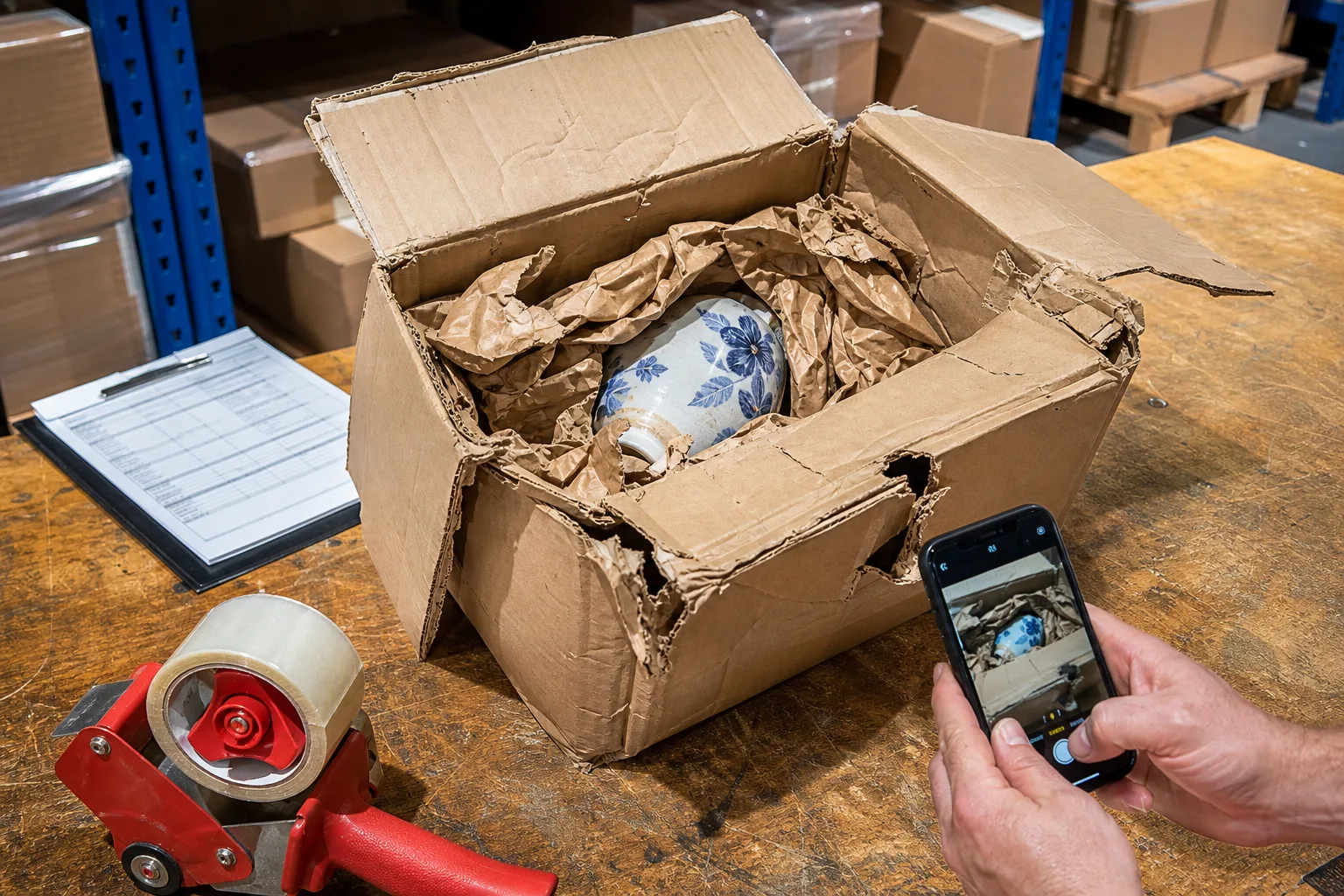
The practical consequence shows up in the adjudication. When a claim is filed, the carrier will often request photographs of the outer carton, the inner void fill, the item as it sat in the box, and the label placement. Those photographs are not a formality. They are the test. A claim that arrives without them, or with a picture of a broken mug on a kitchen counter and nothing else, has already failed on evidence before anyone considers the merits.
Diagnosing the fault before choosing the remedy
Damage rates are a symptom, and the temptation is to treat the symptom by adding material: more bubble, a heavier board grade, a second box around the first. Sometimes that works. Often it moves the failure somewhere else, because the mechanism was never impact in the first place. Compression damage from stacking in a trailer looks nothing like a corner drop, and vibration damage, where a product abrades against its own packaging over hundreds of road miles, leaves scuffs and loosened fasteners that no amount of foam around the outside will prevent.
The cheapest diagnostic is your own returns photography, sorted by failure mode rather than by SKU. Corner crush, lid separation, product-to-product contact, label obliteration and water staining are five different faults with five different fixes, and a week of tagging inbound returns will tell you which one you actually have. After that, paid testing earns its keep. A drop and vibration sequence run by an accredited lab against a recognized transit protocol costs real money per configuration, but it produces the one thing a claims department respects: documentation that the package was designed against a standard rather than assembled by feel.
That documentation is also what converts a packaging argument from opinion into record. When a carrier asserts insufficient packaging, a test report against a published protocol is a direct answer, and shippers who hold one tend to see denials reversed at a rate that pays for the testing within a season.
What changed, and why the old habits stopped working
Two things shifted underneath the average shipper in the last several years. The first is the network itself. Parcel volumes pushed carriers deep into automated sortation, with more induction points, faster belt speeds, and fewer human hands per package, which changed the load profile a box experiences. A carton that survived a slower, more manual network in 2015 may fail now not because anyone is careless but because the physical handling is different, and packaging designed against the old conditions is being asked to do a new job.
The second is commercial. Dimensional weight pricing made empty space expensive, and the response across the industry was tighter boxes with thinner void fill, which is exactly the trade that raises damage rates if it is made without testing. At the same time, marketplaces began requiring ship-in-own-container designs, where the retail package is the shipping package and there is no overbox to absorb abuse. That requirement came bundled with lab testing protocols and approved-vendor programs, which is why formal transit testing moved from a large-manufacturer practice to something a mid-sized seller now buys as a matter of course.
The third change is on the coverage side. Package protection offered at checkout, the small toggle a customer clicks for a couple of dollars, has drawn regulatory attention in several states over whether it is an insurance product or a merchant promise, and some programs restructured accordingly. That matters to you because the two behave differently when a customer files. A merchant promise is your money, administered by a vendor. An insurance product sits with a licensed carrier and is regulated as such.
Three ways to carry the loss, and who each one suits
Declared value through the carrier is the simplest to buy and the narrowest in what it delivers. You pay per hundred dollars of declared value, the maximum is capped, high-value and fragile categories are excluded or restricted, and every claim is adjudicated by the same organization that would otherwise be paying it. For occasional high-value shipments on an account with a clean history, it is fine. For a business shipping fragile goods daily, the per-shipment cost compounds and the denial rate on packaging grounds becomes the operating problem.
Third-party parcel cover, purchased through a broker or bundled into a shipping platform, generally prices below carrier declared value at volume, pays faster because the adjudicator has no incentive to defend the network, and covers categories the carriers exclude. The trade is documentation discipline: filing windows are short, proof-of-value requirements are specific, and a policy will still exclude damage attributable to inadequate packaging, which returns you to the test report.
Self-insuring means pricing expected damage into your unit economics and paying claims from a reserve. It is the right answer more often than people expect, particularly for low-value, high-volume goods where the cost of a replacement is less than the cost of covering it. It requires that you actually measure your damage rate, hold the reserve rather than spending it, and keep improving the package, because with self-insurance every prevented failure is money you keep.
The useful order is diagnosis, then packaging, then coverage. A shipper who knows the failure mode, has a tested carton, and has chosen the coverage that matches the value of the goods will settle most damage quietly and cheaply, and will win the arguments that remain because the file was built before the box ever moved.