Hiring a Professional for the First Time? How to Tell When an Hourly Rate Is the Honest Price
A first-time buyer of professional services can learn to read a fee structure the way a practitioner does, by starting with scope, rework and who honors the promise.
| Published | Section | Business & Trade | |
|---|---|---|---|
| Author | Adaeze Nwachukwu | Reading time | 4 min |
The first invoice you receive from an attorney, an accountant, a consultant or an architect will teach you more about fee structures than any conversation you had before the work started, which is exactly the wrong order. By then the money is spent and the lesson is retrospective. What a first-time buyer needs is a way to form a view in the room, before signing, using only what is in front of them. That judgment is learnable, and it starts somewhere other than the rate.
The rate is the last number to look at, not the first
An hourly rate tells you what one hour costs and nothing about how many hours there will be. A fixed fee tells you the total and nothing about what is inside it. Both numbers are meaningless on their own, which is why comparing a $340 hour against a $4,000 flat fee is not a comparison at all until you know the scope attached to each. Read the scope paragraph first, twice, and only then look at the price. If the scope is three vague lines, the price is a guess no matter which structure sits underneath it.
A well-written scope names the deliverable, the number of rounds of revision, the meetings included, and the specific events that push the work outside the agreement. Filing one amended return is a scope. Handling your tax matters is not. The practitioners who write tight scopes tend to be the ones who have been burned by loose ones, and that history is worth paying for. When you find a scope you can read and restate in your own words to a skeptical friend, you have found the firm worth negotiating with.
What each structure is actually built to handle
Hourly billing exists because some work genuinely cannot be sized in advance. Litigation where the other side controls the pace, a dispute that may settle in a week or grind for two years, a diagnostic engagement where the first three days determine what the next thirty look like: in all of these, a fixed fee is either padded for risk or set low and renegotiated the moment reality arrives. An honest practitioner will tell you which category your matter falls into, and the willingness to say that out loud is one of the better signals you will get.
Fixed and outcome-linked fees fit work with a known shape. A trust package, a trademark application, an audited financial statement, a permit set for a straightforward addition: these are repeated enough that the firm knows its own average and can price around it. Pay for the outcome when the outcome is definable and the path to it is mostly within the firm's control. Pay by the hour when the path is controlled by a court, an agency, a counterparty or the thing nobody has looked at yet. The structure should follow the uncertainty.
Read the rework clause before you read anything else
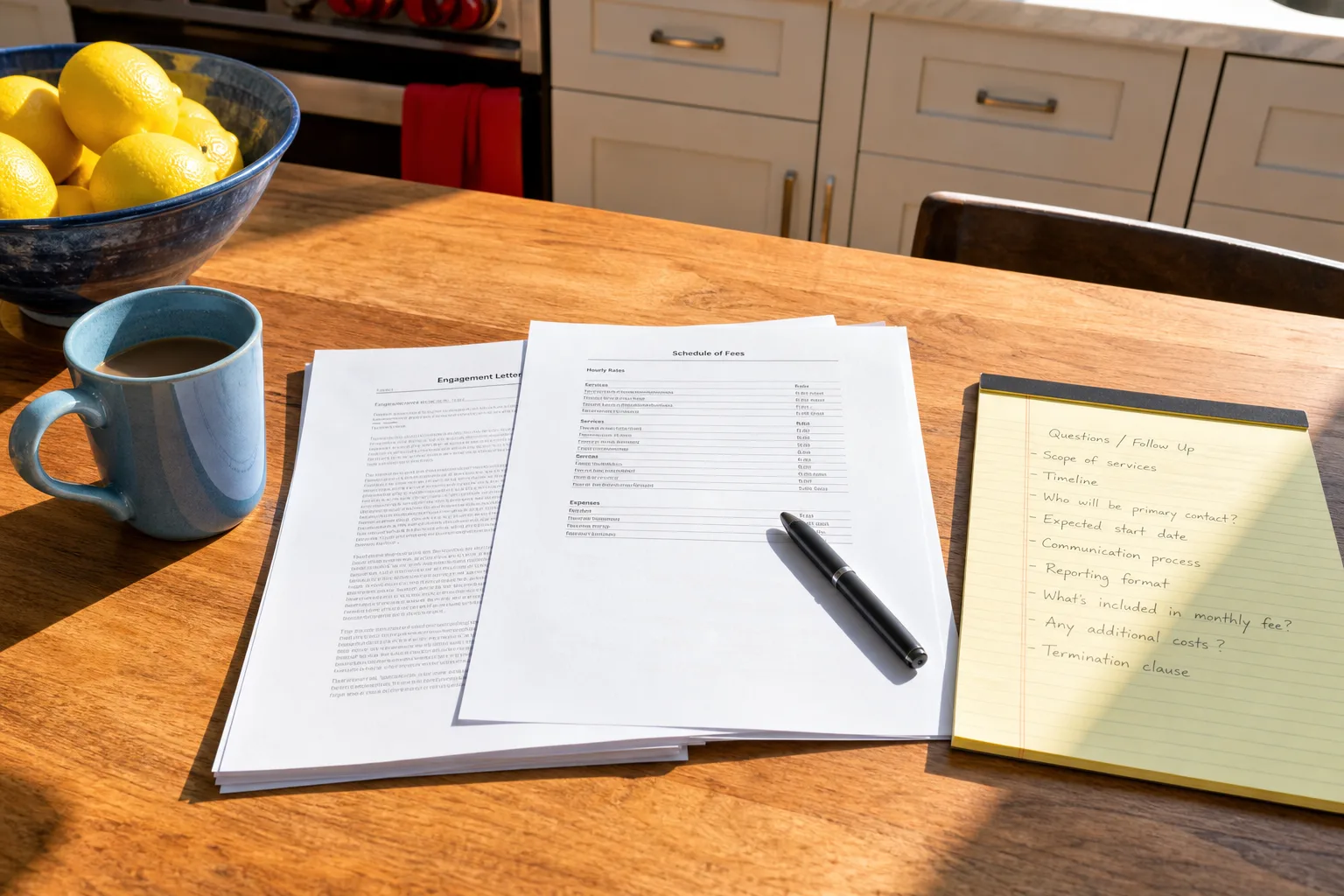
Every engagement letter has a passage about what happens when the work is wrong, and most first-time buyers skip it because it reads like boilerplate. It is not. Find out how long the firm will correct its own errors at no charge, what specifically voids that promise, and whether the promise survives a change in your circumstances or a change in the law. A fixed fee with no rework period is a fixed fee for the first attempt only. An hourly arrangement that quietly bills you for fixing the firm's mistakes is worse than it looks.
Then ask the question almost nobody asks a small firm: who stands behind this if you retire, merge or close. Solo practitioners and two-partner shops do all three. Ask where the file goes, who is named as successor, whether there is a continuity arrangement with another firm, and whether professional liability coverage is written on a claims-made basis with tail coverage purchased. A practitioner who answers that calmly and specifically has thought about your position after they are gone, which is a decent proxy for how they think about everything else.
Three questions that build the judgment quickly
Ask what the last three matters like yours actually cost, not what they were quoted. The gap between those two figures, and whether the firm can produce them without flinching, tells you how well they know their own work. Ask what the most common reason is for a matter like yours to run over, and listen for a specific cause rather than a shrug about every case being different. Ask what you can do to reduce the hours, because the firms that answer concretely are the ones not relying on your disorganization as a revenue line.
Then put a cap on it. On hourly work, ask for a not-to-exceed figure with written notice before any overrun, which converts an open meter into a bounded one without pretending the work is more predictable than it is. On fixed work, ask what triggers a change order and what the hourly rate becomes when the scope opens up. The Federal Trade Commission oversees how services are advertised and billed to consumers, and a firm comfortable putting its fee terms in plain writing is generally comfortable for the same reasons it is good at the work.
The judgment you are building is narrow and durable: match the fee structure to who controls the pace, insist the scope be readable, and know who honors the promise after the engagement ends. Three matters in, you will read a letter in ten minutes and know where to push. The first one takes an afternoon and a pen, and it is the cheapest afternoon in the whole relationship.