Court Date in Three Weeks? The Four Offices That Hold What Your Lawyer Needs
Before a first consultation on a traffic citation, four other people already hold the documents that decide the advice you get. Here is how to collect them.
| Published | Section | Law | |
|---|---|---|---|
| Author | Adaeze Nwachukwu | Reading time | 5 min |
A citation arrives with a date on it and very little else, and most people spend the first week deciding whether to call anyone at all. By the time they do call, the useful material is scattered across four offices that have nothing to do with each other: the court clerk, the state licensing agency, the insurance carrier, and in some cases an employer's safety department. None of those offices will volunteer anything. Each will hand it over to the person named on the record, usually within a few days, and often for a small fee or none at all.
The clerk's window sets your calendar before anyone else does
The clerk's office is the first place to call, and the call is short. You want three facts: what your current court date actually is, what type of hearing it has been set as, and whether your jurisdiction allows that setting to be changed by written request or only in person. Those answers decide whether your consultation is a planning session or an emergency. A mitigation hearing and a contested hearing are different proceedings with different outcomes, and people check the wrong box on the response form more often than they realize, sometimes giving up the argument they wanted to make.
Ask the clerk, in the same call, whether the officer's narrative and any calibration or certification records in the file are available to you, and how. Some courts release them on request to the defendant, some only through a formal discovery demand that counsel files. Either way, knowing which rule applies saves an attorney a phone call you could have made yourself. Write down the name of the person who answered and the date. Clerks are accurate and busy, and a second call that starts with a name moves faster than one that starts over.
Read your own driving record before anyone reads it to you
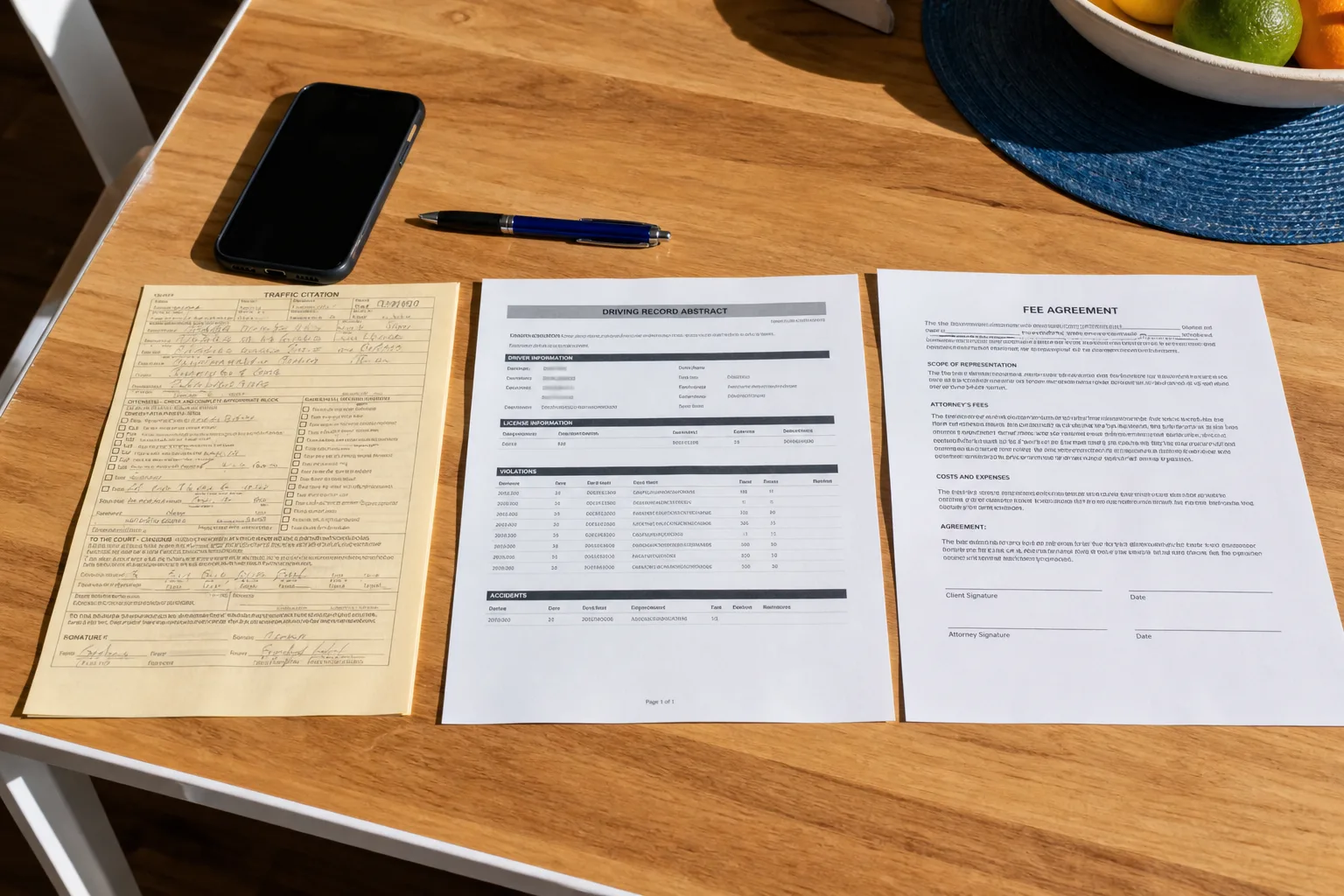
Every state keeps an abstract of your driving history, and the version your insurer sees is not always the version you remember. Order it directly from the licensing agency, in whatever form they issue to the driver, and read every line. You are looking for prior findings within the lookback window, any deferral or diversion you have already used and therefore cannot use again, and administrative actions you may have forgotten, such as a suspension lifted years ago. The gap between a first offense and a third is the entire conversation, and the record settles it.
Errors appear. A citation that was dismissed can sit on the abstract as committed, usually because a disposition never transmitted, and that correction belongs to the agency rather than the court you are headed to. Finding it before the meeting changes the advice you get, because an attorney pricing a case assumes the record in front of them is accurate. Commercial license holders have an additional layer: the Federal Motor Carrier Safety Administration oversees the standards that govern commercial driver qualification, and a disposition that looks minor on a personal license can be treated quite differently against a CDL.
The insurer and the employer are why the number matters
A fine is a known quantity. The surcharge is not, and it is usually the larger figure over three years. Your agent can tell you how the carrier treats a moving violation in your state, how long it affects the rate, and whether a finding of committed on a lesser infraction carries the same weight as the original charge. Get that answer before the consultation, because it converts an abstract choice between outcomes into two dollar figures you can compare. Agents give this answer readily. They would rather quote a hypothetical than process a cancellation later.
If you drive for work, the employer's policy is a third rule set sitting on top of the other two. Many fleet and delivery policies trigger on the fact of a conviction rather than its severity, and a few trigger on the citation itself once it is reported. Read the handbook section before you meet anyone, because an outcome that is fine for your insurance may still cost you a route. When you describe this to a traffic ticket attorney, you are no longer asking what is possible, you are asking what gets you to a specific result your job can live with.
The intake call is the first draft of your case
Most firms route the first contact through a paralegal or an intake coordinator, and what that person types becomes the summary the attorney reads before you walk in. Treat the call as part of the representation. Give the citation number, the issuing agency, the exact charge as written, the court and the date, and say plainly whether you have prior findings. Then ask how they want documents: a portal, an email address, a secure link. Sending a legible scan of the citation and your abstract in advance is the single thing that most changes what the first meeting is worth.
Ask who will actually appear. In high-volume practices, the attorney you meet and the attorney who stands up in court are sometimes different people, and that is not a problem so long as you know it in advance and know the handoff is written somewhere. Ask how you will be told the outcome, and how quickly. The answer tells you something about how the office runs, which matters more than any claim made on the phone.
Read the fee agreement the way you would read a guarantee
Flat-fee engagements are common in this work, and the fee is only as clear as the scope paragraph beneath it. Find out what the fee covers and where it stops: one hearing or all of them, a continuance requested by the prosecution, a trial date if the case does not resolve, an appeal, a motion to reopen if you miss a date. Then find what voids it. Missed appointments, a failure to respond to the court directly, and new citations arising while the matter is pending are the usual three, and they are usually enforceable.
If anything is phrased as a refund promise, pin down who decides it has been triggered, how long you have to ask, and what form the refund takes. A promise tied to a dismissal is a narrower thing than most people hear. Ask, too, what happens if the attorney leaves the firm or the firm closes mid-matter: your file belongs to you, and a well-run office will say so immediately and tell you how it would be transferred. Firms that have thought this through answer without hesitation, which is itself the information you came for.
The work of preparing is mostly phone calls to people who are not lawyers, made in the first week rather than the last. Do them in that order, keep what each office sends in one folder, and the hour you pay for becomes an hour of strategy rather than an hour of intake.