Your Upkeep List Isn't Failing on Discipline. It's Failing on Where the Ladder Lives
Most household maintenance schedules collapse for reasons that have nothing to do with willpower, and the everyday faults they produce are rarely traced back to the list.
| Published | Section | Homes | |
|---|---|---|---|
| Author | Malcolm Greenhalgh | Reading time | 4 min |
A sticking back door in August, a dishwasher that smells like a wet towel, a garage door that judders at the halfway point, an electric bill that crept up eleven percent without anyone changing their habits. Each of those gets treated as its own small problem, diagnosed on its own, sometimes paid for on its own. Almost none of them get filed where they belong, which is under a task somebody stopped doing about fourteen months earlier. I have watched apprentices learn this sequence in reverse, fixing the symptom first for two or three years before they start recognizing the shape of the neglect behind it.
The faults that never get traced back to a skipped task
Service work teaches you to read backwards. A condenser coil packed with cottonwood seed does not announce itself as a dirty coil; it announces itself as a system that cools fine in May and struggles in July, and the homeowner calls it a capacity problem. A toilet that needs two flushes is usually mineral in the rim jets, not a weak valve. Cabinet hinges that sag were dry for a year. The reason these go unconnected is that the consequence arrives in a different season, in a different room, and often in a different budget line than the five-minute job that would have prevented it.
The financial version is quieter still. Nobody sees the difference between a heating system that was serviced each fall and one that was not, because you cannot compare your own house to itself. The Department of Energy is the federal body responsible for tracking residential energy use, and the general shape of the finding is that filters, coils and duct connections account for more of a household's comfort complaints than equipment age does. That is the part apprentices find hardest to accept in year one, because cleaning does not feel like repair.
What the first year of a trade actually teaches about upkeep
An apprentice's first year is largely custodial, and it is not hazing. You drain the compressor tank at the end of the day, you wipe the torch tip, you coil the cord the same way every time, you clean the threader before it goes back in the van. The instruction is relentless and it is about tools, not buildings. What it installs, though, is the habit of tying a small maintenance act to the end of an activity you were already going to finish. Nobody writes "drain compressor" on a calendar. It happens because the day ends.
That is the whole mechanism, and it takes most people years to transfer it from the van to the house. The schedules that hold in real households are not the ones built from a printable checklist organized by month. They are the ones attached to something that already reliably happens: the first cold night, the week the clocks change, the day the pool closes, the trip to the dump, the return of the holiday decorations to the attic. If the task has no host event, it has no future.
Location beats the calendar every time
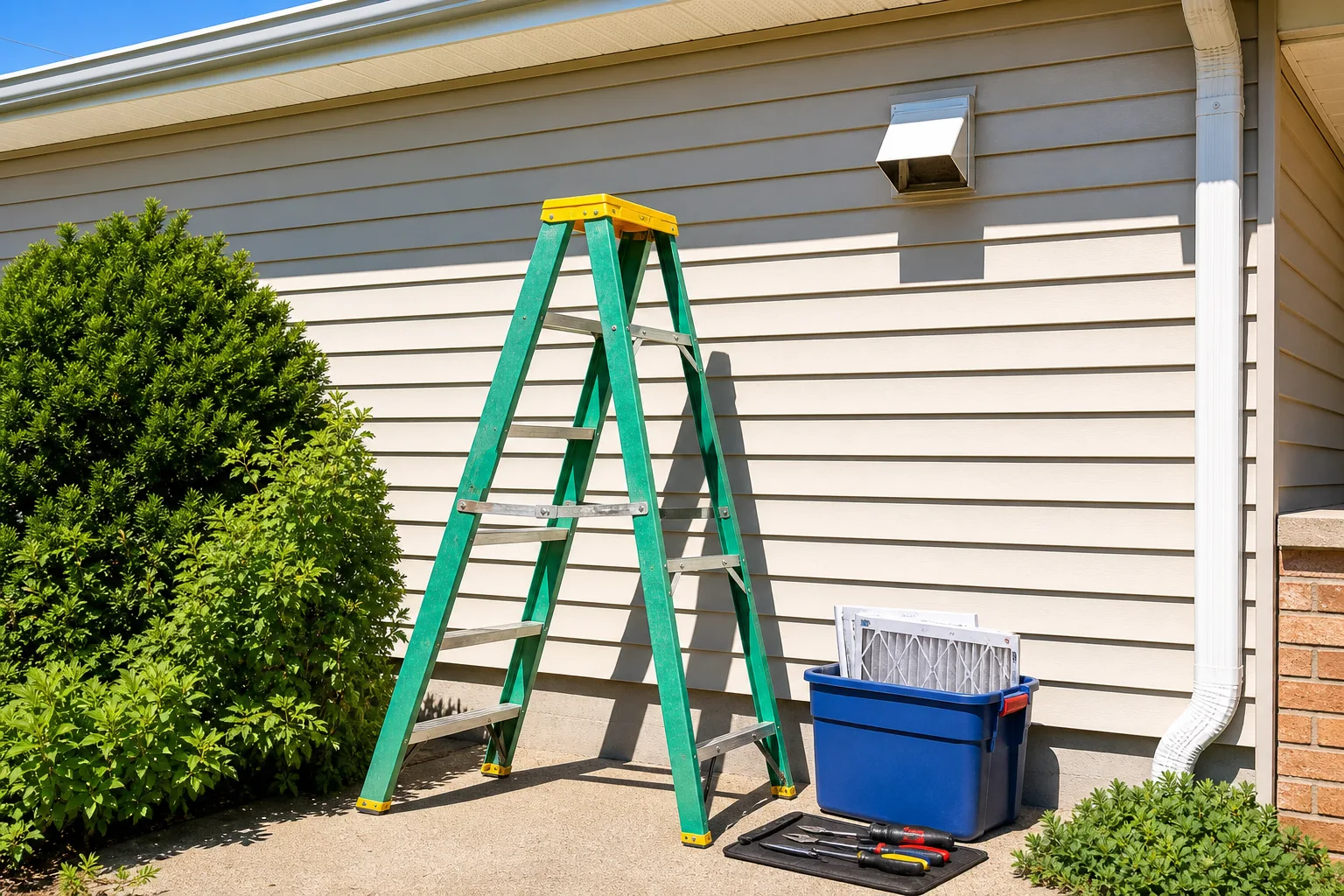
The second thing experience changes is grouping. A monthly list will tell you to check the water heater in one month and the furnace filter in another, which means two trips to the same utility closet, two interruptions, and two chances to decide you are busy. Tradespeople batch by location because setup is the expensive part. If the ladder is already up and level, you clear the gutter, look at the flashing, check the dryer vent hood, wipe the exterior light lenses and eyeball the roof edge in one session. Splitting those across three weekends triples the ladder work and roughly triples the dropout rate.
So the practical test for any schedule is where the tools live. If your ladder is behind a car and under a tarp, every roof-adjacent task on your list is fiction, however good your intentions. Homeowners who keep their upkeep current almost always have an accessible ladder, a labeled filter shelf with the right sizes in stock, and a small tote that does not get raided for other jobs. Buying the next two filters in advance does more for adherence than any reminder app, because the task fails at the supply step far more often than at the willpower step.
The parts worth handing to someone else
There is a line, and knowing where you personally sit on it is the useful skill. Filters, gutters, drain screens, door hardware, dryer ducts, weatherstripping and appliance gaskets are all genuinely homeowner work, and they are the tasks where a kept schedule shows up as money not spent. Combustion adjustment, refrigerant, panel work, anything requiring a manometer or a vacuum gauge, and anything on a steep roof belong to someone who does it daily. When you hire for those, ask what they clean and measure as part of the visit, not just what they replace. The answer tells you how they were trained.
Ask the same question of yourself once a year. A list of six tasks anchored to events you cannot miss, with the parts already on the shelf and the ladder reachable in under a minute, will outperform a thirty-item annual plan every time, and the household will feel it in doors that close, bills that hold steady, and equipment that quietly reaches its second decade.