The Sexton, the Setter and the Engraver. Who Actually Decides What You Can Order
A memorial is made and set by three or four people whose week-to-week constraints shape your choices long before the catalog does, and some of those choices never reopen.
| Published | Section | Family | |
|---|---|---|---|
| Author | Adaeze Nwachukwu | Reading time | 4 min |
The first thing worth knowing about ordering a grave marker is that you are not buying a product off a shelf, you are buying a place in four separate work calendars, and those calendars do not line up. There is the monument dealer who takes the order, the quarry or distributor who supplies the stone, the engraver who cuts it, and the setting crew who pours a foundation and places it in the ground. Each has a busy season, a slow season, and a weather window. Your decision sits next to their week, and the week usually wins.
The dealer's year runs on frost and backlog
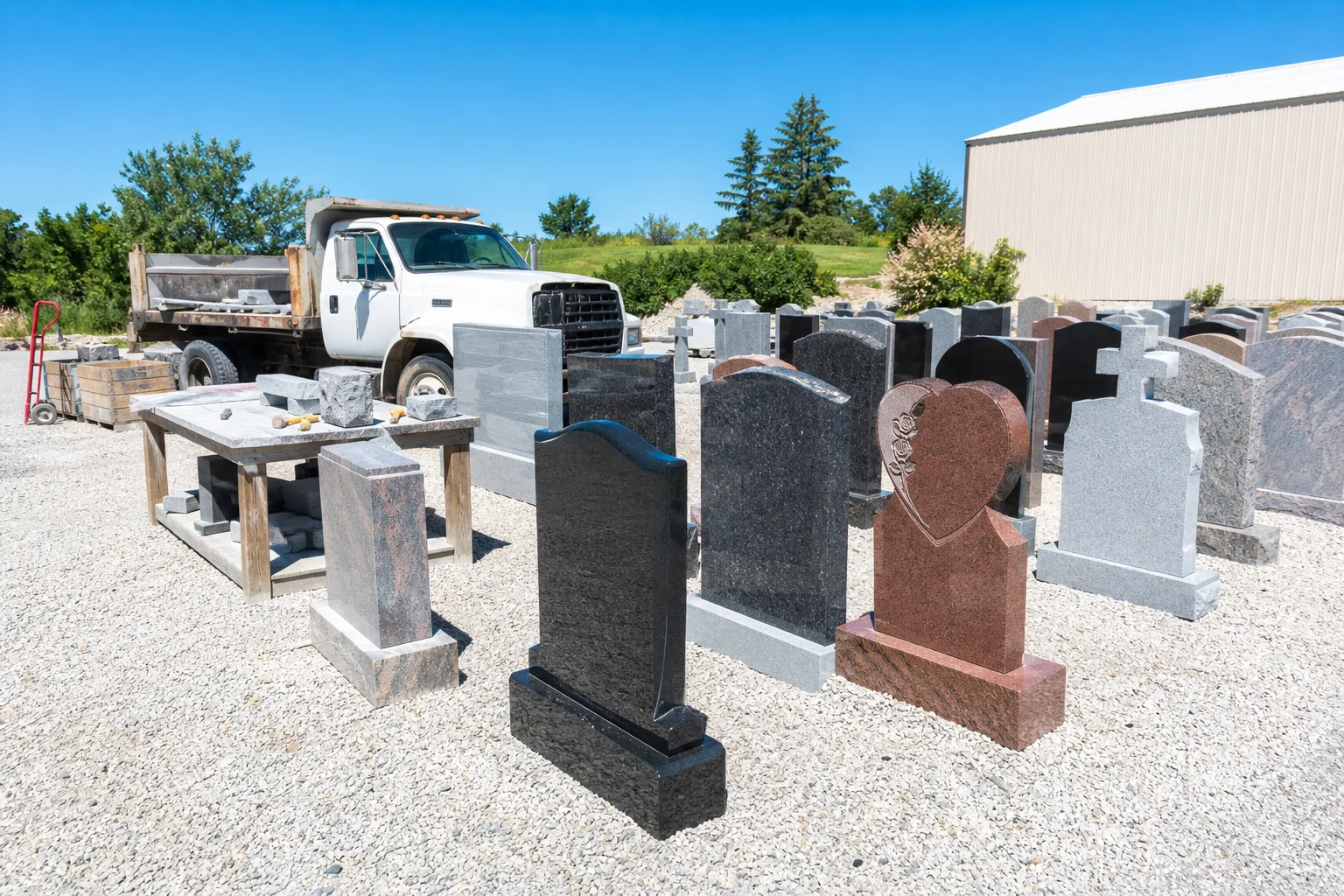
Walk into a monument shop in late April in a northern state and the yard is full of finished stones waiting to go out, because the ground has only just released and the setting crews are working through everything ordered since November. Walk in during August and the same shop may quote you a faster turnaround on cutting but a slower one on setting, because the crew is booked across several counties. Southern shops run on rain and cemetery mowing schedules instead of frost. Ask the person at the counter what their current gap is between proof approval and installation, and ask what month they expect that gap to widen.
That one question reorders most of what follows. If setting is eight weeks out, you have eight weeks to make decisions that feel urgent and are not. If the stone itself is a stock size in a common granite, the dealer may have it in the yard already. If you want a color that comes from a specific quarry, you are now waiting on a shipment someone else controls, and the dealer is passing along a date rather than promising one. Families who understand this stop pushing for speed and start pushing for accuracy, which is the thing that actually cannot be fixed later.
The cemetery office sets the envelope
Before a single design choice matters, someone in the cemetery office has to say yes. That person works from a written set of rules governing size, height, material, base thickness, whether vases are permitted, whether a flat marker is required in that section, and who is allowed to pour the foundation. Many cemeteries will only accept a foundation poured by their own grounds crew, billed separately from the memorial, and scheduled on their calendar rather than the dealer's. The sexton or office manager is usually the single most useful person in the process, and the easiest to reach, because answering this is their ordinary week.
Call them before you shop. Ask for the rules in writing, ask what the foundation charge is and who invoices it, and ask whether the deed holder on the plot has to be the one signing the installation permission. That last point stops more orders than any design question. When you then compare headstones for sale across dealers, you are comparing things that can actually be installed where your family is buried, rather than falling for a shape that section does not allow.
The engraver works from your proof, not your intentions
Lettering is cut by a person working from an approved layout, usually sandblasted through a rubber stencil cut from the file you signed off on. They do not know your grandmother. They know the file. If the middle initial is wrong, if the death date was transposed, if the surname carries an accent that got stripped somewhere between the handwritten order form and the design software, the stone will be cut exactly that way and it will be correct according to the paperwork. Recutting is sometimes possible on an uncarved area. Replacing a stone is a new stone at a new price.
So treat the proof as the last reversible moment, because it is. Print it. Read the dates backward, digit by digit, against a death certificate rather than against memory. Have a second family member who was not involved in the ordering read it cold. Check the spelling of the cemetery's own section or lot number if it appears. Check which side the stone is being cut on, since a double marker set for a spouse's later inscription has a fixed orientation. Ask where any future date will be added and whether that space has been reserved in the layout.
Read the guarantee before you read the price
Granite memorials are routinely sold with lifetime or perpetual guarantees, and those words carry less weight than they appear to. Ask what the guarantee actually covers: the stone itself against splitting or discoloration, or also the lettering, the sealant on a bronze plate, the vase hardware, the leveling of the base after settling. Ask what voids it. Pressure washing, certain cleaning products, wreath wires, and ground-maintenance damage from the cemetery's own mowers are common exclusions. Ask whether the guarantee is the dealer's or the quarry's, because that determines who you are actually relying on.
Then ask the question nobody enjoys. If this shop closes in twelve years, who honors this. A guarantee backed by a manufacturer or a trade association may transfer. A handshake from a two-person shop generally does not, whatever the certificate on the wall says. Keep the signed guarantee, the proof, the foundation receipt and the cemetery's written permission in one folder with the deed. The Federal Trade Commission oversees disclosure practices in funeral goods and services, and the habit of getting terms in writing serves you here exactly as it does at the funeral home.
Sequence the decisions that lock
Work in this order and very little goes wrong. Confirm the plot and the deed holder, get the cemetery rules, choose size and material within those rules, then design, then proof, then schedule the foundation, then set. Price comparisons belong between the rules and the design, not before. The decisions that genuinely cannot be undone are the inscription, the stone's dimensions once cut, and the foundation's position once poured.
Families who give the proof an extra two days almost never regret it. The crews who set these stones will tell you the same thing, quietly, while they are leveling a base in a field in October.