Offered Half of What You Asked? How to Price the Rest Before You Answer
A settlement offer is only meaningful next to what the alternative now costs, and remote hearings, raised small claims limits and third-party warranty administrators have all moved that number.
| Published | Section | Law | |
|---|---|---|---|
| Author | Adaeze Nwachukwu | Reading time | 6 min |
The offer on the table is never good or bad on its own. It is only good or bad next to the thing you would do instead, priced honestly, including the hours you would spend and the parts of the claim you would probably lose. Most people compare the offer to what they asked for, which is the one comparison that tells them nothing. Building the judgement to settle well means learning to price the alternative quickly, in a specific county, against a specific counterparty, with a specific piece of paper behind it. That skill is learnable, and several things have recently made it cheaper to exercise.
Price the alternative before you price the offer
Start with the recovery you could realistically prove, not the recovery you feel owed. A contractor who installed the wrong subfloor owes you the cost to correct it, evidenced by a written estimate from another licensed outfit, not the aggravation of six weeks of dust. Then subtract what pursuing it costs: the filing fee, the service fee, an expert or a second estimate if the case turns on workmanship, and the hours you will not bill or work elsewhere. Then discount the remainder by the odds that a judge sees it your way, which for a documented, photographed, estimated claim is decent, and for a verbal understanding is not. What survives that arithmetic is your walk-away number.
Now compare. If the offer clears the walk-away number, the argument for pressing on is emotional rather than financial, and there is no shame in taking a clean check. If the offer sits well below it, you have a reason to keep going that you can explain in one sentence, which is exactly what you will need when the other side asks why you refused. The people who settle well are not the ones who fight hardest or fold fastest. They are the ones who did this calculation before the phone rang, so the answer took a minute rather than a week.
What changed, and why the math moved
Three shifts in the last few years have made the alternative cheaper, which quietly raises the offer you should be willing to refuse. First, remote and hybrid hearings, adopted widely during the pandemic and retained in many small claims and civil divisions because they cleared backlogs, mean a hearing may cost you ninety minutes at a laptop instead of a full day of lost wages and parking. Second, a number of states have raised their small claims jurisdictional limits, some substantially, which pulls disputes that once required an attorney into a forum where you can appear yourself. Third, court systems have moved filing and evidence submission online, so photographs, estimates and text messages arrive as uploads rather than as a folder handed to a clerk.
The other change runs the opposite direction and is easy to miss. Warranties and guarantees are increasingly administered by third parties rather than by the company whose name appears on the truck. The installer sells the labor guarantee, an administrator carries the obligation, and an insurer stands behind the administrator. That layering is why a firm can close and a guarantee can still pay, and it is also why the phone number on your paperwork may reach someone who has never heard of the person who did the work. Knowing which layer holds your obligation changes who you should be negotiating with, and often improves the answer.
The four routes, compared on what they actually cost you
Direct negotiation is free, fast and reversible, and it is the only route where you can trade something other than money, such as agreeing to a partial repair or a schedule. Its weakness is that it has no deadline, so a counterparty who wants to run out your clock will happily keep talking. A card chargeback, where you paid by credit card and the window is still open, is the cheapest leverage most consumers have, and the issuer decides in weeks rather than months, but the windows are shorter than people assume and are measured from the transaction or the expected delivery date, not from the day you got angry.
Mediation sits in between, costs a few hundred dollars split between the parties in most community programs, and is now a required step before trial in a growing number of courts, which means you may be doing it whether or not you chose it. It works when both sides want out and fails when one side simply does not have the money. Small claims is the backstop: modest fee, no attorney required in most states, a real judgment at the end, and a collection problem afterward if the defendant has nothing to take. A licensing board complaint or a state contractor recovery fund pays slowly and only in defined circumstances, but it survives the contractor's bankruptcy, which no judgment against that contractor will.
Read the guarantee before you answer the offer
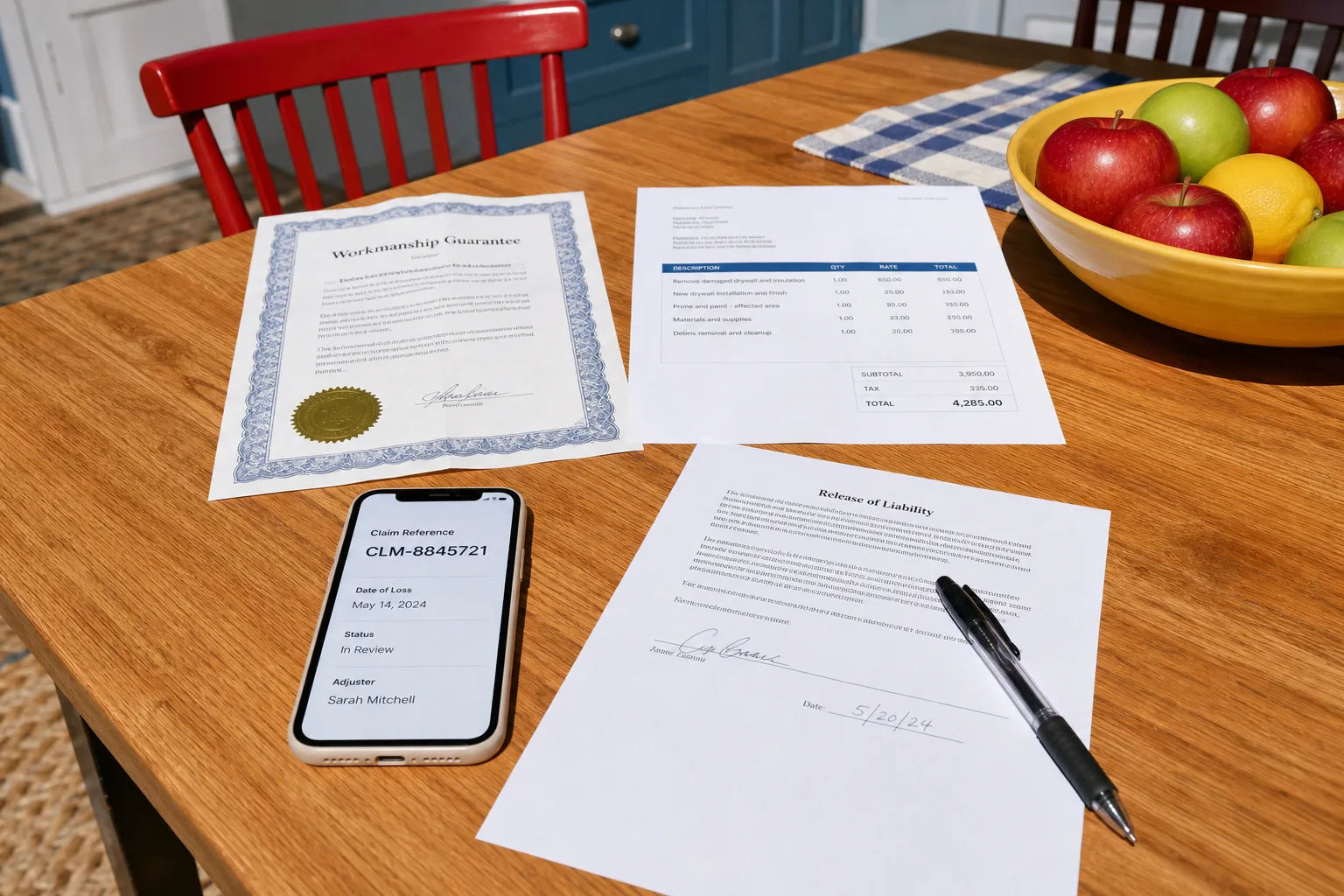
The document you signed usually decides which of those routes is even open. Look for the term, and whether it runs from substantial completion or from final payment, because those dates can sit months apart. Look for what voids it, which is commonly any repair attempted by another party, so accepting a partial settlement and hiring someone else to finish can extinguish coverage worth more than the settlement. Look for transferability if you plan to sell. And look for an arbitration clause, because if one is there and enforceable, your small claims backstop may not exist, and the cost profile of the alternative changes entirely. The Federal Trade Commission oversees consumer warranty practices and the disclosures that go with them, and reading the terms with that framing, as obligations someone must honor rather than reassurance, is what turns a guarantee from a comfort into an asset.
Two questions settle most of it. Who is the obligor, named in full, and are they still trading? If the answer is an administrator or an insurer rather than the installer, your negotiation partner changes and your odds usually improve, because an administrator has a claims process, a reputation with dealers and no personal grievance with you. Ask for the claim number in writing, keep every submission in one folder with dates, and you will find the offers arrive faster and larger.
Signals that the number in front of you is the top of the range
An offer improves when the other side's own cost of continuing rises, so watch for the moments that raise it: a hearing date set, an inspection scheduled, an insurer put on notice, a board complaint acknowledged. When those have already happened and the number has not moved in two rounds, you are probably near the ceiling. Another tell is the shape of the offer rather than its size. Money plus a release, offered promptly and in writing, generally means someone has priced their exposure and wants it closed. Money offered in installments, or contingent on you doing something, means they are managing cash, and the certainty of a smaller check today may genuinely beat the larger promise.
Get the release language before you agree in principle. A release that covers the whole project when the dispute concerned one room is a different deal from the one you thought you accepted, and the correction is usually a single sentence limiting the scope to the identified defect and preserving the manufacturer's product warranty. Ask for it plainly. Counterparties who want the matter closed will nearly always agree, because the sentence costs them nothing and buys them the signature.
Judgement here is mostly a habit of sequence: price the alternative, find the obligor, check the clock, then read the offer. Do it once carefully on a small dispute and the next one takes an afternoon.