The Monument Dealer Closed Four Years In. Who Was Left Honoring the Guarantee?
A family's granite marker came with a lifetime guarantee, a foundation nobody claimed, and a dealer who shut in year four. What the paperwork actually promised, and who paid.
| Published | Section | Family | |
|---|---|---|---|
| Author | Adaeze Nwachukwu | Reading time | 4 min |
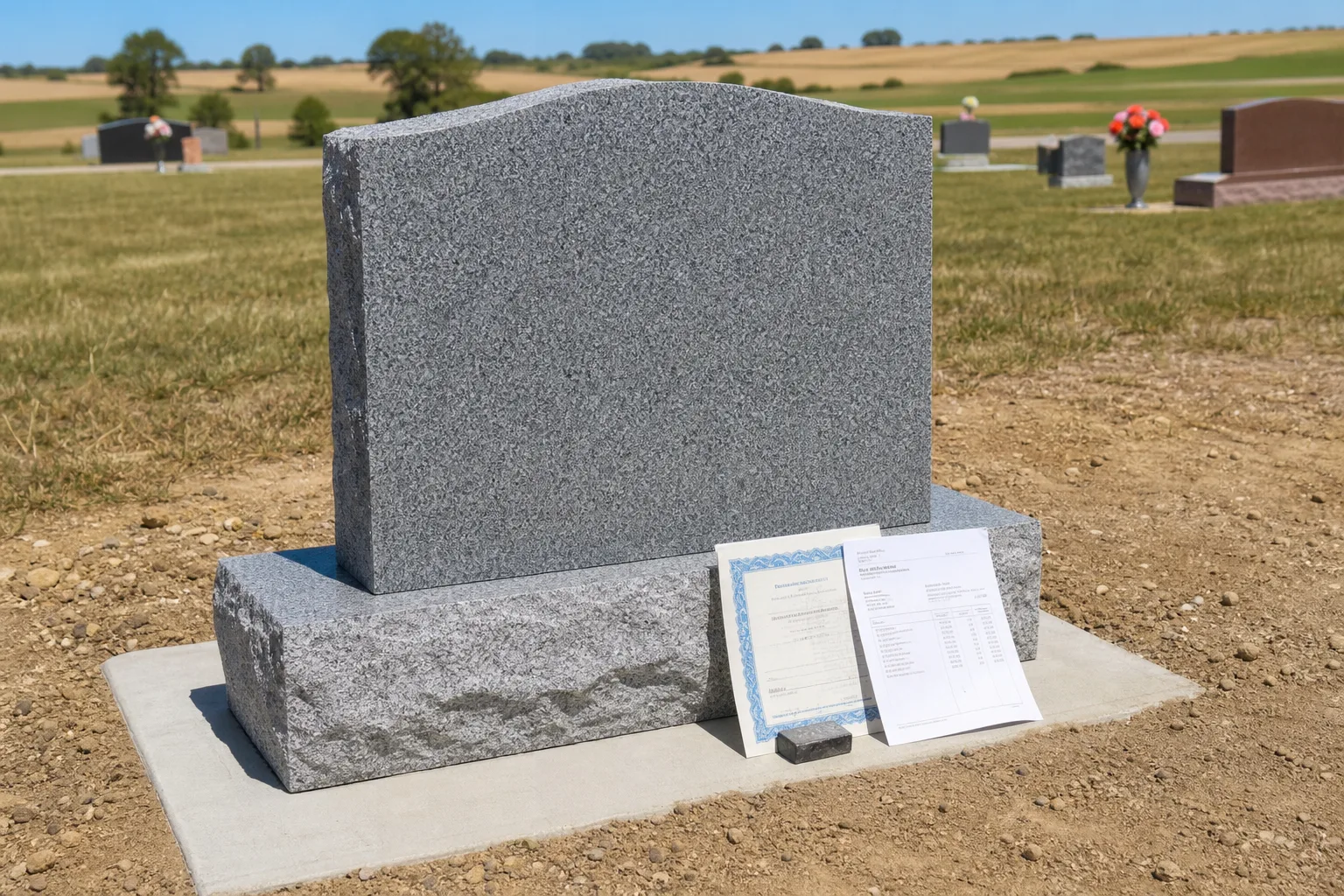
The order was placed in late spring, at a shop two towns over from the cemetery, by a family who had already chosen the plot and wanted the stone set before the first anniversary. Barre gray granite, a modest upright, two names with room for a third, a shallow rose carved on the left shoulder. The dealer handed over a folded certificate with the word guarantee across the top and the word lifetime inside it. Four years later the shop was gone, the lettering had gone chalky on the north face, and the family learned that three different parties each owned a piece of the answer.
Three separate promises, sold as one
What the family thought they had bought was a single warranty on a single object. What the paper described, once it was read line by line, was three promises with different owners and different lifespans. The granite itself carried a quarry or manufacturer guarantee against splitting, spalling and color loss, which is the durable part and the part that almost never gets claimed. The dealer's own workmanship guarantee covered the cutting, the polishing and the lettering, and it ran only as long as the dealer did. The setting, meaning the concrete foundation and the seal that holds the die to the base, belonged to whoever poured it.
In this case the cemetery poured it, because the cemetery required its own crew to do so and charged a separate foundation fee, itemized on a separate invoice the family had filed in a different envelope. That separation matters more than it sounds. When a stone leans, the granite is usually fine, the carving is usually fine, and the problem is under the grass. The family who reads only the certificate with the word lifetime on it will chase the wrong party for months before anyone tells them the foundation was never the dealer's work at all.
The clauses that quietly do the voiding
The chalky lettering turned out to be a maintenance question rather than a defect, and the guarantee had anticipated exactly that. Most monument warranties exclude the paint or enamel in the letters, which is a coating and is expected to be refreshed, and many exclude any damage from cleaning products the manufacturer has not approved. Household bleach, wire brushes, pressure washers and off-the-shelf stone cleaners all appear on those exclusion lists somewhere. So do de-icing salts, mower and string trimmer contact, tree roots, ground settlement, vandalism, and what one common form calls acts beyond the control of the seller.
Read plainly, that leaves a guarantee that covers the granite failing as granite, and very little else. The family in this case had done nothing wrong, but a neighbor two rows over had scrubbed a marker with a bathroom cleaner on a hot afternoon and etched a permanent shadow into the polish, then discovered the certificate would not help. Ask the dealer, before the order goes in, for the written cleaning instructions the warranty relies on. Ask what the cemetery's own crew uses when it works around the stones, since the grounds contract can void your paper without anyone in your family touching it.
What survived the shop closing, and what did not
When the shop closed, the workmanship half of the guarantee closed with it. There is no fund standing behind a monument dealer's promise the way state preneed trusting rules stand behind money paid in advance for funeral goods and services, and the family had not paid in advance for anything undelivered, so no trust applied. What did survive was the manufacturer's guarantee, because it had been issued in the quarry's or the manufacturer's name rather than the retailer's, and because the family still had the certificate with the serial or order number on it.
That is the practical test, and it is worth applying in the showroom. If the certificate carries only the retailer's letterhead, the promise is worth exactly the retailer's remaining years in business. If it carries a manufacturer's name and a claim address, another dealer who handles that manufacturer's product can usually process a claim for you, sometimes for a service fee covering removal and resetting. The family found a shop in the county seat willing to do that, refreshed the lettering as routine maintenance rather than a claim, and confirmed the granite was sound. The Federal Trade Commission oversees disclosure in the sale of funeral goods and services, which is the reason itemized pricing and written terms are the norm rather than a favor; ask for both in writing at the memorial counter as well.
The decisions that close before the stone is cut
Everything reversible about a memorial is decided in the first two weeks, and the reversible window is shorter than families expect. Size, thickness, granite color, finish and base dimensions all have to satisfy the cemetery's written rules before the order is confirmed, and those rules govern flush markers, upright heights, vase policies and photo ceramics with more force than any catalog. Once the design proof is signed and the stone goes to the sandblast room, the lettering is permanent. A misspelled maiden name is not a warranty claim. It is a new stone.
So the useful sequence is to get the cemetery's rulebook and its foundation fee schedule first, then choose within it, then read the guarantee before signing rather than after delivery. Hold the deposit on a credit card if the shop allows it, since the dispute window gives you a route the certificate does not. Photograph the finished stone the week it is set, from three angles in good light, because a claim four years later turns on what the surface looked like at installation. Keep the certificate, the design proof and the foundation invoice in one envelope with the deed.
The family got what they wanted in the end: a sound stone, crisp letters, a level base, and a folder that tells the next generation who to call. It cost them a few months of phone calls they could have skipped by asking two questions in the showroom, namely whose name is on this guarantee and who pours the foundation. Those two answers, written down, are worth more than the word lifetime printed across the top.