Just Took Over the Household Paperwork? The Fall Pull That Finds Every Deadline You Inherited
The seasonal turn moves renewals, enrollment windows and tax bills all at once. Here is how a first-timer finds them from statements rather than from memory.
| Published | Section | Family | |
|---|---|---|---|
| Author | Sebastian Kowalczyk | Reading time | 4 min |
The job usually arrives without a handover. Someone moves out, someone dies, someone takes a job with longer hours, and the person left holding the mail discovers that a household runs on about thirty recurring obligations nobody ever wrote down. Fall is when this becomes obvious, because the season stacks renewals, enrollment windows and tax bills into roughly eight weeks. The instinct is to start filing. That treats the symptom. The cause is that you do not yet know what exists, and no folder system will help you honor a deadline you have never heard of.
Start with twelve months of statements, not with a filing cabinet
The fastest diagnostic available to a first-timer costs nothing and takes an afternoon. Pull twelve months of checking account and credit card statements, and read every line, marking anything that repeats or that appears exactly once a year. Annual charges are the ones that matter, because monthly bills announce themselves and yearly ones do not. That single pass will surface the umbrella policy, the alarm monitoring contract, the well testing service, the chimney sweep, the domain renewal for a family email address, and the professional license that quietly funds itself from a card you assumed was dormant.
What you are building is not a budget. You are building a calendar of dates you did not choose, which is a different document and a more useful one. Note the charge date, the amount and the merchant name as it appears on the statement, because that string is often the only way to identify a vendor whose paperwork went to an old address. Two or three lines will resist identification. Call the number on the back of the card and ask who the merchant is, which is a service the issuer provides and most people never use.
Which documents have to exist in full, and which can stay a line item
Not everything needs a copy. The test worth applying is whether you would need the document at the moment things go wrong, when the office is closed and the website is asking for a policy number you do not have. Insurance declarations pages pass that test, all of them: homeowners, auto, umbrella, flood if you carry it, and any rider covering a ring, an instrument or a collection. So does the deed, the survey if one was ever done, the mortgage statement showing the escrow analysis, the most recent property tax bill, and the manufacturer paperwork for anything under warranty with a serial number on it.
Everything else can live as an entry on your list with a vendor, a date and a phone number. Utility bills, paid receipts under a couple hundred dollars, and the third year of a maintenance contract you no longer hold do not need storage. The distinction saves you from the common first-timer failure, which is building a beautiful set of folders, filling them with paper that will never be reopened, and running out of patience before reaching the four documents that actually decide outcomes.
The toolkit is smaller than the internet suggests
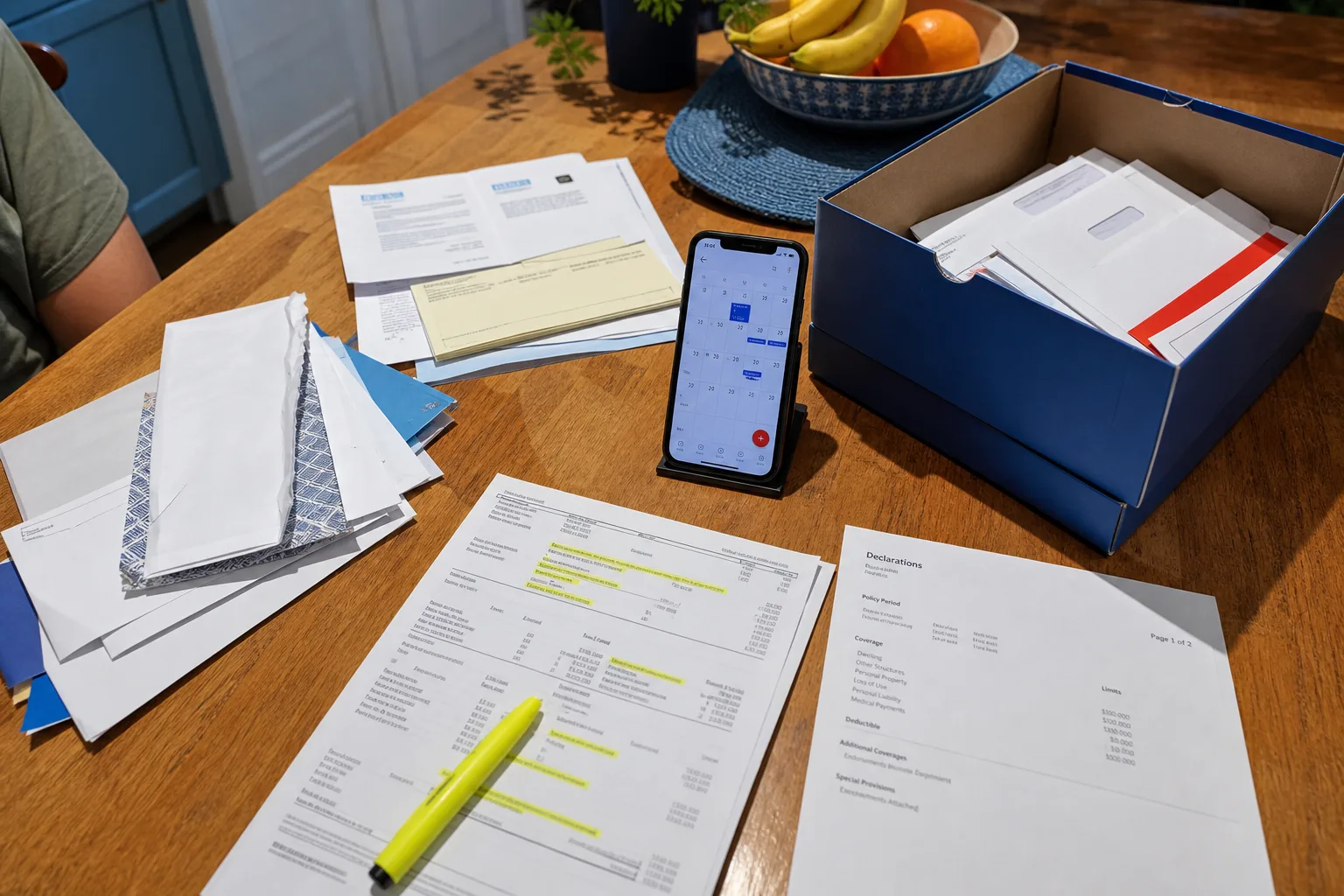
Four things carry almost all of the load. A shared calendar, with each renewal entered at its true date and again thirty days earlier, because a notice that arrives on the deadline is a notice about a decision already made for you. A scanner, which for most households is a phone app that produces searchable files rather than photographs. One email address used for household accounts, so that vendor mail lands in a place both adults can reach and neither treats as personal. And a password manager holding the logins, since a portal you cannot enter is functionally a document you do not have.
The fifth item is a physical box, and the reason for it is behavioral rather than administrative. Mail arrives daily and gets sorted rarely, so the box is where unopened items wait for the weekly twenty minutes when you actually process them. What makes the system survive contact with a real family is that the weekly session has a fixed slot and a defined end. Anything unresolved goes back in the box with a date written on the envelope, which is a small habit that prevents the pile from becoming undifferentiated.
What the season itself moves onto the list
Fall carries a distinct set. Employer benefits open enrollment usually runs a two or three week window with a hard close, and the default if you do nothing is rarely the plan you would have chosen. Homeowners and auto policies commonly renew on anniversaries clustered around the change of address or purchase date, and the renewal declarations page is the one chance each year to check that dwelling coverage has kept pace with what rebuilding now costs. Property tax bills land in many jurisdictions between September and December, and escrow analyses follow, changing the monthly mortgage payment without asking.
Layered on top are the seasonal service commitments: the heating system inspection that some warranties require documentation of, the snow removal contract that prices better before the first storm than after it, the gutter cleaning that has to follow leaf drop rather than precede it. Automatic renewal terms sit underneath several of these, and the Consumer Financial Protection Bureau oversees much of the disclosure that governs how recurring charges and mortgage servicing statements reach you. Read the cancellation window on any contract you inherited, because those windows are frequently thirty days before the anniversary rather than on it.
By the second year the statement pull takes an hour instead of an afternoon, because you are confirming a list rather than discovering one. The first pass is the expensive one, and it is expensive in attention rather than money, which is the trade most households would take if anyone had told them it was on offer.