Insured to Value, or Just Insured? Where the Averaging Clause Takes Its Cut
Coinsurance penalties and replacement cost conditions reduce payouts before the deductible does, and the rules that govern them change at the state line.
| Published | Section | Money & Finance | |
|---|---|---|---|
| Author | Adaeze Nwachukwu | Reading time | 4 min |
The number that decides most disputed property claims is not the deductible and not the loss estimate. It is the limit you chose, measured against what the building would actually cost to rebuild on the day it burned or blew apart. If that ratio falls short, two separate mechanisms are waiting, one written into commercial policies as a coinsurance clause and one buried in the loss settlement condition of a homeowners form. Both do the same arithmetic. They pay a fraction of the repair, then hand you the rest of the bill.
Two mechanisms, one result, different paperwork
On a commercial property policy, the coinsurance clause states a percentage, commonly eighty or ninety, and asks whether your limit met that share of the full replacement value at the time of loss. If it did not, the insurer divides what you carried by what you should have carried and applies that fraction to the claim, deductible taken afterward. A partial loss, which is what most losses are, absorbs the penalty entirely. On the homeowners side there is no clause called coinsurance, but the replacement cost condition usually requires the dwelling limit to meet a stated proportion of full replacement cost before the insurer will pay repair cost rather than depreciated value. Same math, quieter wording.
The practical difference is who notices. A commercial insured usually has a broker who runs the calculation at renewal because the penalty is famous. A homeowner is handed a declarations page with a dwelling limit generated by software, and nothing on that page says the limit was tested against anything. The condition sits four pages into the form, under settlement terms, phrased as an entitlement rather than a warning.
What separates a sound valuation from a box-ticked one
A barely adequate valuation is a square footage figure multiplied by a regional cost factor, refreshed each year by an inflation guard endorsement that raises the limit by a general index. It ignores the things that actually drive rebuild cost: a plaster-and-lath interior, a slate or tile roof, a hillside lot where every yard of concrete arrives by pump truck, a historic district that dictates window materials, a house with no street frontage wide enough for a crane. It also ignores debris removal on a sloped site and the cost of demolishing what survived but cannot be repaired.
A good valuation is a measured cost estimate built from the same line items a contractor would use, priced to local labor, and dated. It names the roof covering and the wall finish. It adds an allowance for code compliance work that current ordinances will force during reconstruction, which on a house built before modern seismic, wind or energy code is rarely trivial. It is documented, so that when a loss comes and the adjuster's own estimating software produces a lower figure, you are comparing two estimates rather than arguing against one. Ask who stands behind the valuation. An appraisal commissioned by the carrier protects the carrier's rating file, not your limit, and the agency that ran it may not be in business in nine years when the fire comes.
The rules change at the state line, and so does the exposure
Where you are determines both how likely a total loss is and what the law does about an inadequate limit. A handful of states, Florida and Texas among them, have valued policy statutes that require payment of the full face amount on a total loss from a covered peril, which removes the averaging argument at the top end while leaving partial losses fully exposed. Several western states have tightened requirements on wildfire exposure after the recent urban conflagrations, pushing carriers to offer extended replacement cost, to lengthen the additional living expense period, and to advance a portion of contents coverage without a room-by-room inventory. Those reforms are state specific and the offer is not always the default.
Local code is the second regional variable, and it moves faster than limits do. A coastal county that adopted a stricter wind standard will require the rebuilt roof to meet it, with a sealed deck, upgraded fasteners and opening protection that did not exist on the house you insured. An inland town that adopted a newer energy code adds insulation, window and mechanical costs. A wildland urban interface overlay adds ember-resistant vents, noncombustible siding and defensible clearance work. None of that is covered by the dwelling limit alone. It is covered by ordinance or law coverage, usually sold as a percentage of the dwelling limit, and a percentage of an inadequate limit is inadequate twice.
Flood sits outside the homeowners policy entirely, and the National Flood Insurance Program, overseen by the Federal Emergency Management Agency, caps residential building coverage at a set amount. On a house worth more than that cap, the gap is not an averaging problem but a hard ceiling, and the answer is excess flood coverage from the private market.
Comparing the endorsements that actually solve it
Inflation guard is the weakest tool, because it compounds an index onto a starting number that may have been wrong. Extended replacement cost is stronger: it pays a stated percentage above the dwelling limit, commonly a quarter or a half, which absorbs both a stale valuation and the cost spike that follows a regional catastrophe when every contractor within sixty miles is booked. Guaranteed replacement cost removes the ceiling altogether and is offered selectively, often with an updated inspection as the price of entry. On the commercial side, an agreed value endorsement suspends the coinsurance clause for the policy term, on the strength of a signed statement of values, and it must be renewed deliberately each year.
Read what voids each of these. Extended replacement cost typically requires that you rebuild at the same location and that you notify the carrier of improvements above a dollar threshold. Agreed value lapses silently if the statement of values is not resubmitted. Ordinance or law coverage often excludes undamaged portions of the structure unless a higher tier is purchased.
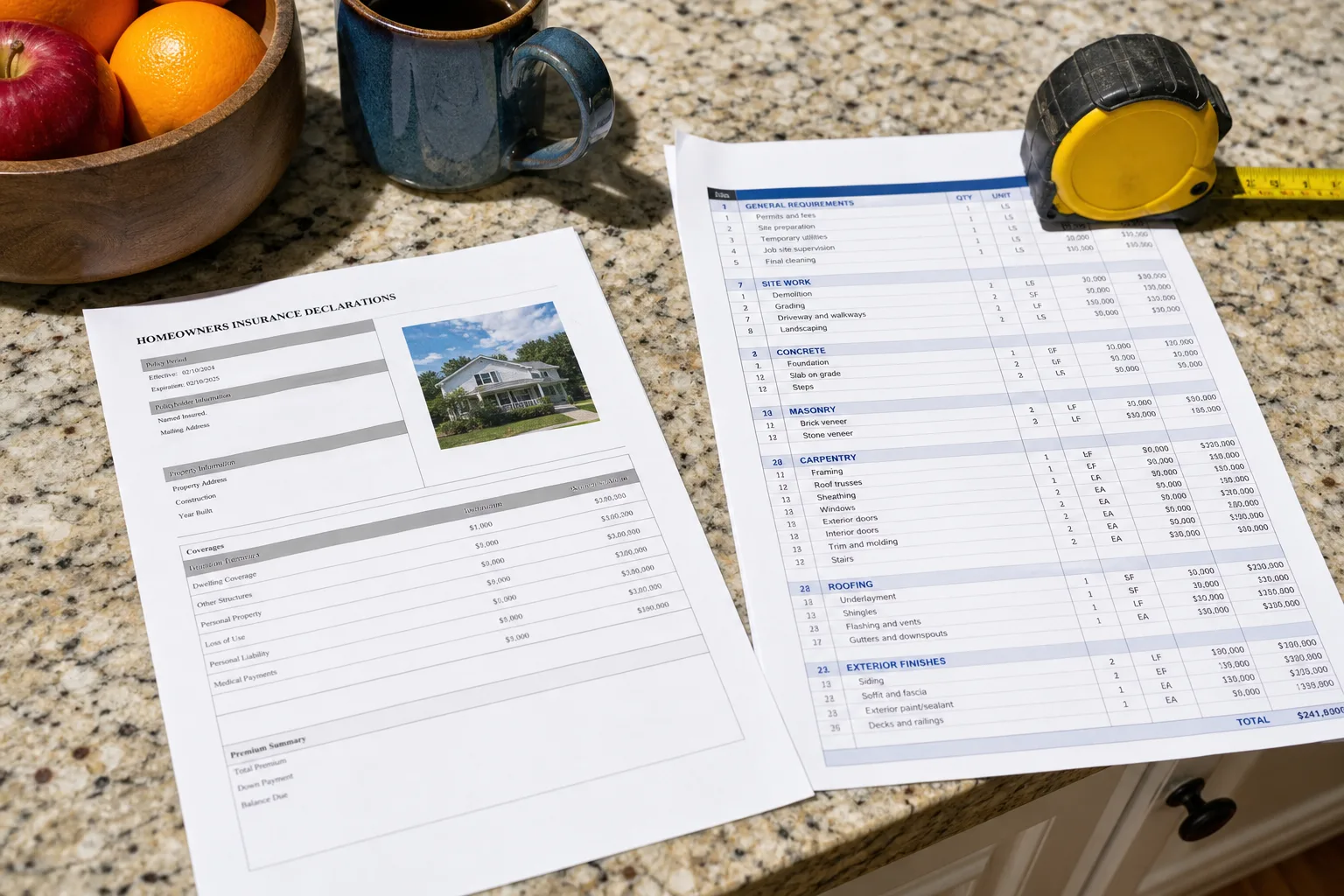
Put the renewal declarations page next to a current contractor's rebuild figure for your zip code, and ask your agent in writing which condition applies to your form and what percentage it demands. That single exchange, kept on file, is what turns a settlement argument into a short conversation.