Five Checks That Turn a Backup You Hope Works Into One You Have Watched Restore
A restore log, an inventory sheet and a retention window set by your own state regulator will tell you more about your backups than any dashboard.
| Published | Section | Technology | |
|---|---|---|---|
| Author | Malcolm Greenhalgh | Reading time | 4 min |
The first thing an apprentice is handed in a shop that takes data seriously is not the backup software. It is a clipboard, a list of machines and an instruction to write down what is on each one. That job is dull, takes two days, and is the reason the person who has done it can answer, three years later, the only question that matters in a bad week: what did we lose. Backup products sell green checkmarks. Green checkmarks are a statement about last night's job finishing, not about whether the file a bookkeeper needs can be put back on a desk by Thursday.
One: watch someone restore it who did not set it up
A backup is a claim, and a restore is the test of the claim. The useful version of that test is not run by the person who built the system, because that person knows which folder is really the live one and which share was abandoned in 2019. Hand it to the newest competent person in the office, give them the written procedure and nothing else, and time them. What you learn in the first twenty minutes is usually not that the data is missing. It is that the encryption passphrase lives in one head, that the recovery console needs an account nobody has, or that the procedure was written for a version replaced two upgrades ago.
Do this quarterly and it becomes a half hour. Do it once a year and it becomes a crisis rehearsal that everyone dreads and quietly postpones. A trade teaches this by repetition, not by lecture: the year-one apprentice restores one file, the second-year restores a folder tree with permissions intact, and the person with real time in the seat restores a whole server to different hardware and knows in advance which three drivers will fight them. Skill here is almost entirely accumulated failure, which is why the test has to happen while the stakes are low.
Two: keep an inventory sheet, and keep it on paper too
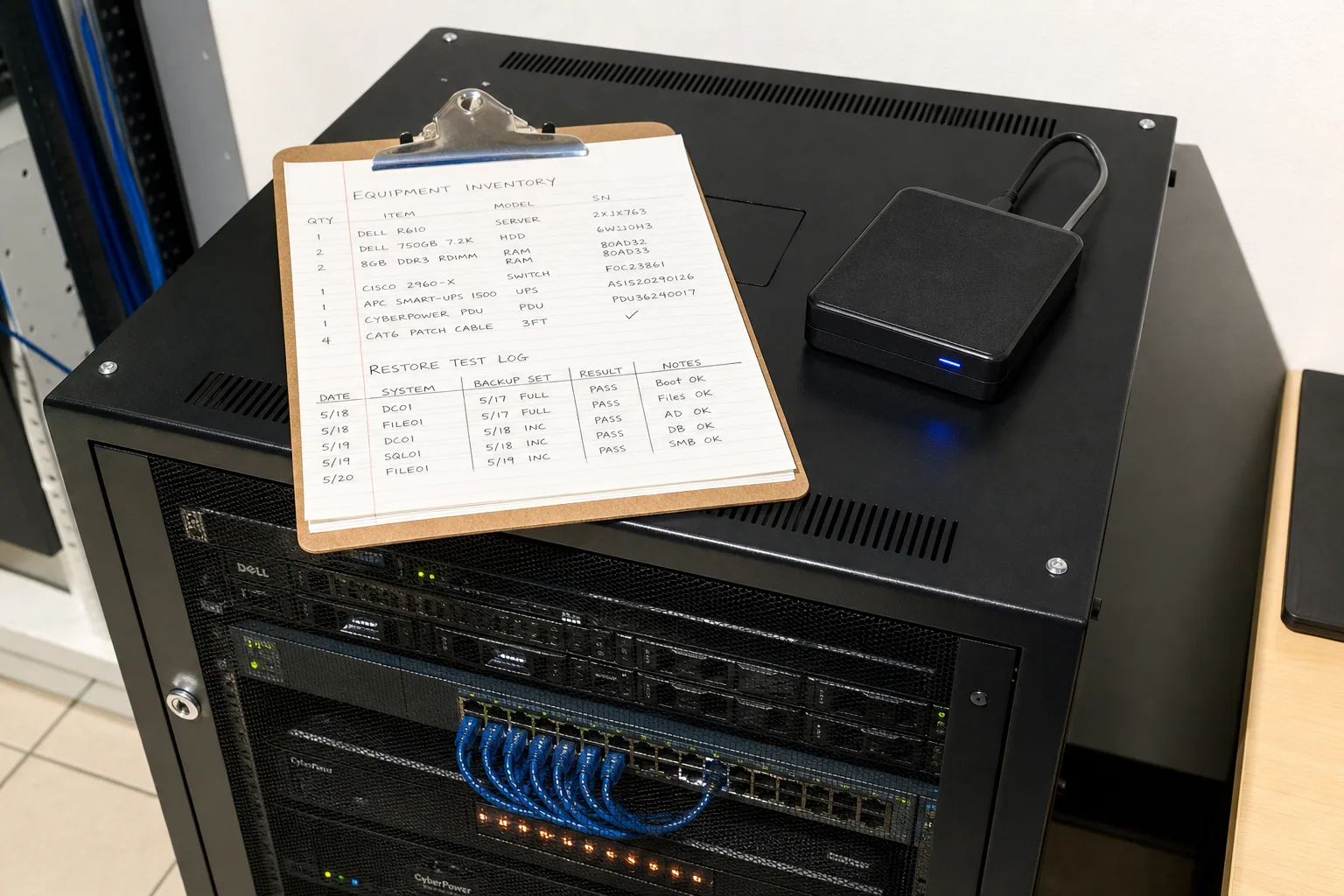
The paperwork that makes backups manageable is thinner than people expect. One sheet listing every system, what data sits on it, who owns it, which backup job covers it and how long copies are kept will carry a small business for years. The value is in the gaps it exposes. Almost every inventory turns up a laptop that holds the only copy of the estimating spreadsheets, a point of sale terminal nobody counted as a computer, or a cloud application whose vendor backs up its own infrastructure but does not restore your individual deleted records without a paid support case.
Keep a printed copy in the same binder as your insurance declarations. During an actual outage, the inventory is frequently on the system that is down, which is the sort of lesson that only needs teaching once. The National Institute of Standards and Technology is the federal body responsible for the security guidance most American organizations end up following, directly or through a customer's contract, and its framing treats recovery documentation as part of the control, not as an optional extra written after the fact.
Three: know where the offsite copy physically sits, and under whose rules
Every serious backup arrangement has a copy somewhere the fire will not reach. Where that somewhere is has stopped being a purely technical question. State data breach notification statutes differ on what counts as personal information, how fast you must notify, whether the state attorney general gets a copy of the letter and, importantly, whether encrypted data that is lost triggers the obligation at all. Several states offer a practical safe harbor when the exposed data was encrypted and the key was not taken with it, which turns disk encryption on your backup target from a nice habit into a documented legal position.
Ask your provider, in writing, which state or country the copies live in and whether replication moves them. A shop in Vermont and a shop in Texas can buy the identical service and end up with different notification duties and different contract terms behind the same web console. If your work touches health records, student records, or anything a client's contract calls confidential, the local rule may also be a sector rule layered on top, and the answer belongs in the same binder as the inventory sheet.
Four: set the retention window from the rule that governs you, not the default
Backup software ships with a retention default chosen to keep storage bills predictable. Your obligations were chosen by other people. The IRS expects supporting records for returns to be available for a period that varies with what happened on the return, state licensing boards frequently set their own minimums for client files, and a county or municipal contract can require that project documentation survive years past closeout. Contractors, medical practices and anyone holding personnel files usually find the longest number is not the federal one.
Write the number next to each line on the inventory sheet, with the source of the number beside it. That single column resolves most arguments later, because the question stops being how long feels prudent and becomes which rule applies to this specific record in this specific state. It also stops the opposite failure, where a firm keeps everything forever and finds that a decade of old copies is a decade of exposure it never needed to carry.
Five: log the tests, dated and initialed
The log is one line per test: date, what was restored, how long it took, who ran it, what broke. Handwritten is fine. Its first job is operational, since a pattern of slow restores tells you the target is aging before it fails outright. Its second job arrives when an insurer, an auditor or a client's security questionnaire asks how you know your backups work, and a year of initialed lines answers a question that a screenshot of a dashboard cannot. It is also how a newer employee learns the shape of the system without anyone giving a lecture.
A backup regime built this way is not elaborate. One sheet, one log, a passphrase held by two people, and four supervised restores a year is roughly the whole discipline, and it is teachable to someone in their first month.