First Memorial You've Ever Ordered? What the Screen Proof Cannot Show You About the Stone
A monument proof arrives as a PDF now, not a chalk sketch in a sample yard, and the decisions it locks in are the ones nobody gets to redo.
| Published | Section | Family | |
|---|---|---|---|
| Author | Malcolm Greenhalgh | Reading time | 6 min |
The first time most people order a memorial, they order it in a week when they are not sleeping, and they order it from a PDF. That is the real change of the last decade, more than price, more than material, more than anything in the catalog. Ten years ago the same family would have stood in a gravel yard behind a shop, put a hand on three pieces of granite, and watched someone chalk a name onto a board at full size. Now a proof arrives by email, scaled to a laptop screen, and it looks finished before anything has been decided.
I am interested in how this trade is taught, because the gap between a first-year apprentice and a cutter with twenty years in it is almost entirely a gap in what they can see coming. The apprentice can produce a correct layout. The experienced hand knows which correct layout will still read from eight feet away in flat February light, on that particular stone, after the lettering has weathered for a decade. A first-time buyer is being asked, quietly, to supply judgment that takes years to build.
What the same decision looked like ten years ago
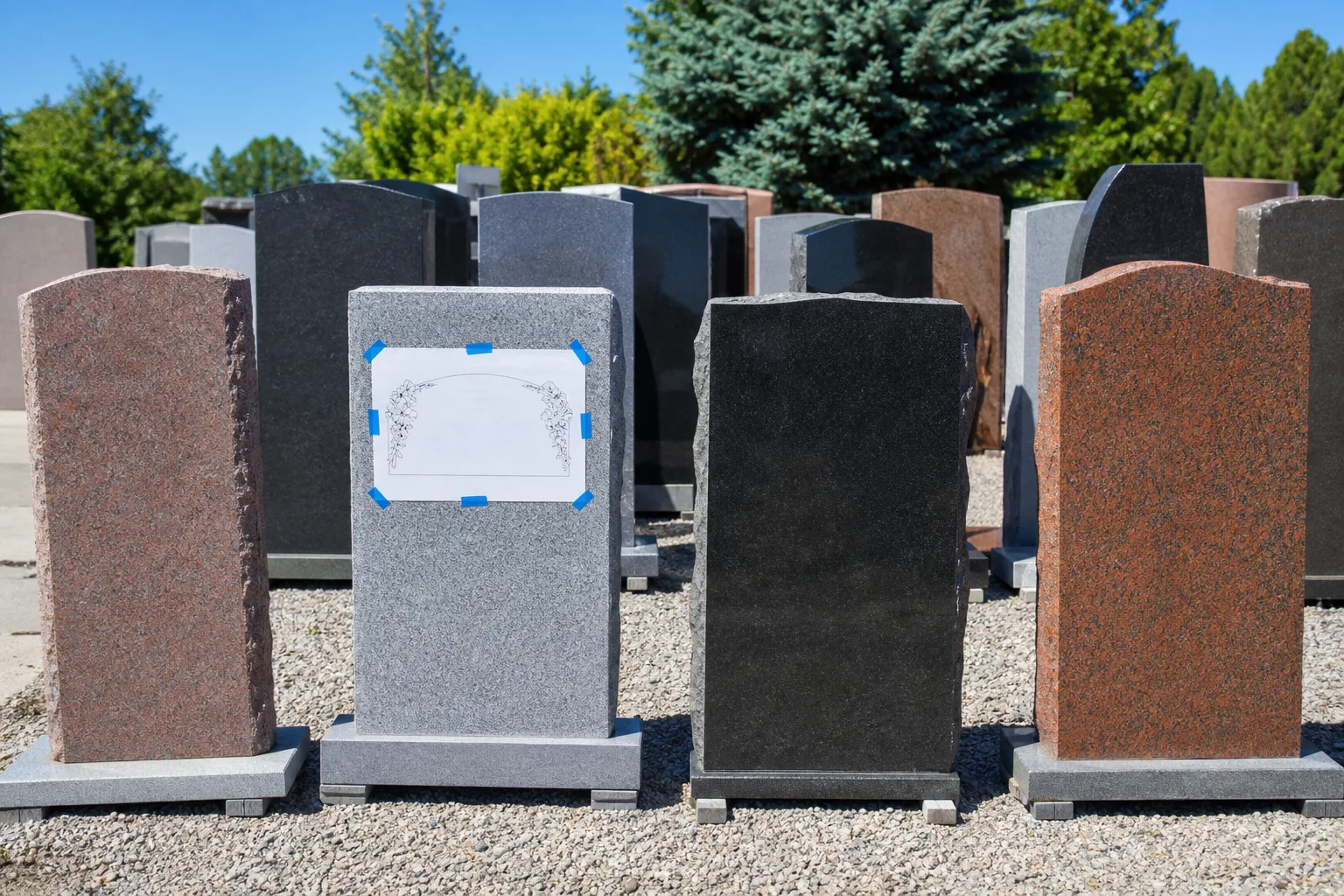
The sample yard did work that nobody wrote down. A family walked the rows, saw that the gray they liked in a brochure was in fact four different grays depending on the quarry run, and noticed without being told that a polished face throws back the sky while a steeled or rock-pitched face does not. They saw a finished stone standing at its real height, with grass around it, which is nothing like a rectangle floating on a white background. They also saw work the shop had done five, ten, twenty years earlier, out in the cemetery, which is the only honest portfolio in this trade.
The paperwork was slower and, in one respect, better. A layout drawn at full size on paper or cut as a rubber stencil forced a pause: somebody had to physically make the thing before anyone approved it, and in that interval errors surfaced. A middle initial appeared that the family had not asked for. A date was read aloud twice. The pause was not a courtesy, it was a consequence of the method, and when the method sped up, the pause had to be rebuilt deliberately or it simply vanished.
What a digital proof settles, and what it quietly leaves open
A proof emailed as a PDF is genuinely better at some things. Spelling is easier to check against a document rather than against someone's handwriting. Revisions cost minutes instead of an afternoon. Families scattered across three states can all look at the same file before anyone signs, which ten years ago meant mailing photocopies or trusting one relative's description over the phone. For a first-time buyer, the ability to sit with the thing overnight, read it again in the morning, and send it to a sibling is worth real money.
What it does not settle is everything physical. Letter depth does not appear on a screen. Neither does the difference between a shallow blast that will fill with lichen and a deeper cut that holds a shadow in overcast weather. Color on a monitor is not color in a quarry, and a stone described as black may read dark green in direct sun. Scale is the worst offender: a design that looks balanced at six inches wide can look thin and crowded at thirty inches, because the eye judges proportion against the body, not against a browser window.
The fix is not to refuse the digital proof, it is to insist the proof be checked against something physical. Ask for the actual stone sample, not a swatch card. Ask the shop to print the layout at full size, which costs them very little and tells you more than ten rounds of emailed revisions. Ask to see a finished memorial of the same material and lettering style already set in a cemetery, and go look at it in ordinary daylight rather than at noon on a clear day when everything reads well.
The choices that have no second attempt
Some decisions are reversible at a cost and some are not reversible at all, and first-time buyers are rarely told which is which. Stone selection is final; you cannot change your mind about granite once it is cut to size. Finish is final on the faces that have been polished. Lettering is subtractive, so an error is corrected by cutting the whole panel down, refinishing, and starting again, if the stone has the thickness to allow it, which it often does not. A misspelled surname is not an edit, it is a replacement.
Then there are the decisions that look optional now and become binding later. Space. If a companion name is going on the stone in twenty years, the layout has to reserve room for it, in the same lettering style, at the same baseline, with the same margins, and that reservation has to be made before the first name is cut. Shops see the consequence constantly: a second name squeezed in smaller, set lower, cut by a different hand in a different decade. Foundation size is the other one, because a base poured for the stone you ordered will not take the stone you wished you had ordered.
The cemetery has its own say, and it says it in writing. Permitted heights, permitted materials, whether vases may be fixed or must be flush, whether a bronze marker is required in that section, and who is allowed to set the foundation. Those rules are not negotiable at the counter, and a design approved by a family but rejected by the cemetery office is a cost somebody absorbs. The Federal Trade Commission is responsible for the rules governing how funeral goods and services are priced and disclosed, which is useful context for the paperwork, but the cemetery's own regulations are a separate document that a first-time buyer has to ask for by name.
What year one teaches, and what only time does
An apprentice in a monument shop learns, early, how to weed a stencil cleanly, how to set type to a drawing, how to run the blast cabinet without burning an edge, and how to proofread a name three times against the source document. That is real skill and it is teachable in months. What takes years is judgment about the material: reading grain so a seam does not run through a letter, knowing that a fine serif will survive on one granite and crumble at the stroke ends on another, understanding how a design ages once rain, mowers and road salt have had a decade at it.
This is why the question to ask a shop is not how long they have been in business but who is doing your layout and who is checking it. A shop with a cutter who trained there, stayed there, and now teaches the next one is a shop where the slow knowledge is still in the building. Ask how long the person handling your order has been doing it. Ask who signs off before the stencil is cut. Nobody minds the question, and the answer tells you most of what you need to know.
Slowing the decision without delaying the stone
A memorial is not required at the funeral, and the calendar in a first-timer's head is usually borrowed from the service, not from the cemetery. Many shops will not set a stone until the ground has settled, which can mean months regardless of when you order. That interval is the one piece of time the process hands you for free, and it is the right place to put the sample yard visit, the full-size printout, the cemetery rulebook, and the conversation about whether a second name is coming.
Use the week you have to make the choices that cannot be unmade, and let the rest of the order follow at the shop's pace. The families who come away satisfied are almost always the ones who saw the stone before they approved the drawing.