Fans Still Running on Day Six? How Fast Drying and Proper Drying Pulled Apart
Drying used to be judged by hand and by smell. Here is how the trade learned to measure it, and what the difference looks like across an ordinary week.
| Published | Section | Homes | |
|---|---|---|---|
| Author | Malcolm Greenhalgh | Reading time | 6 min |
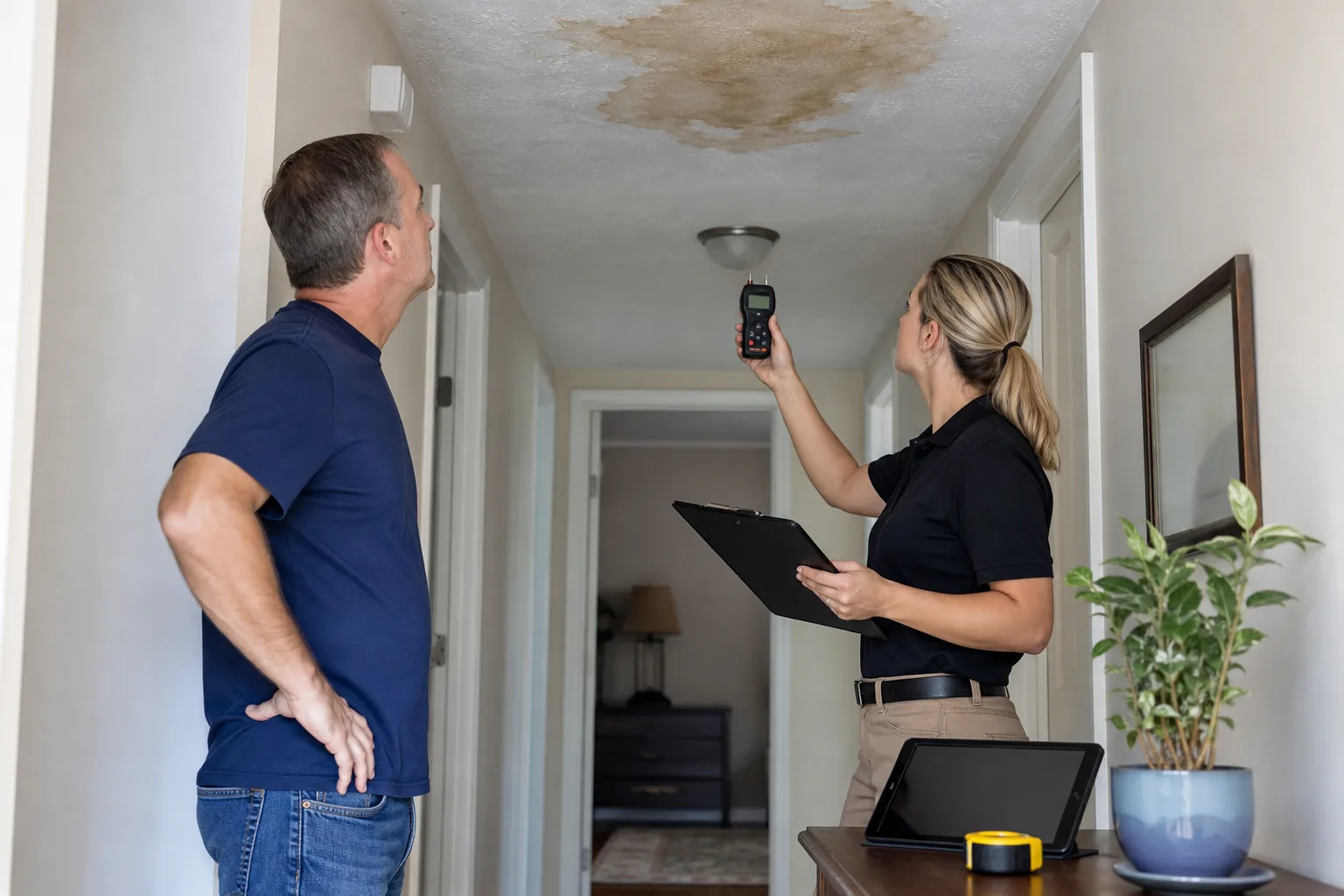
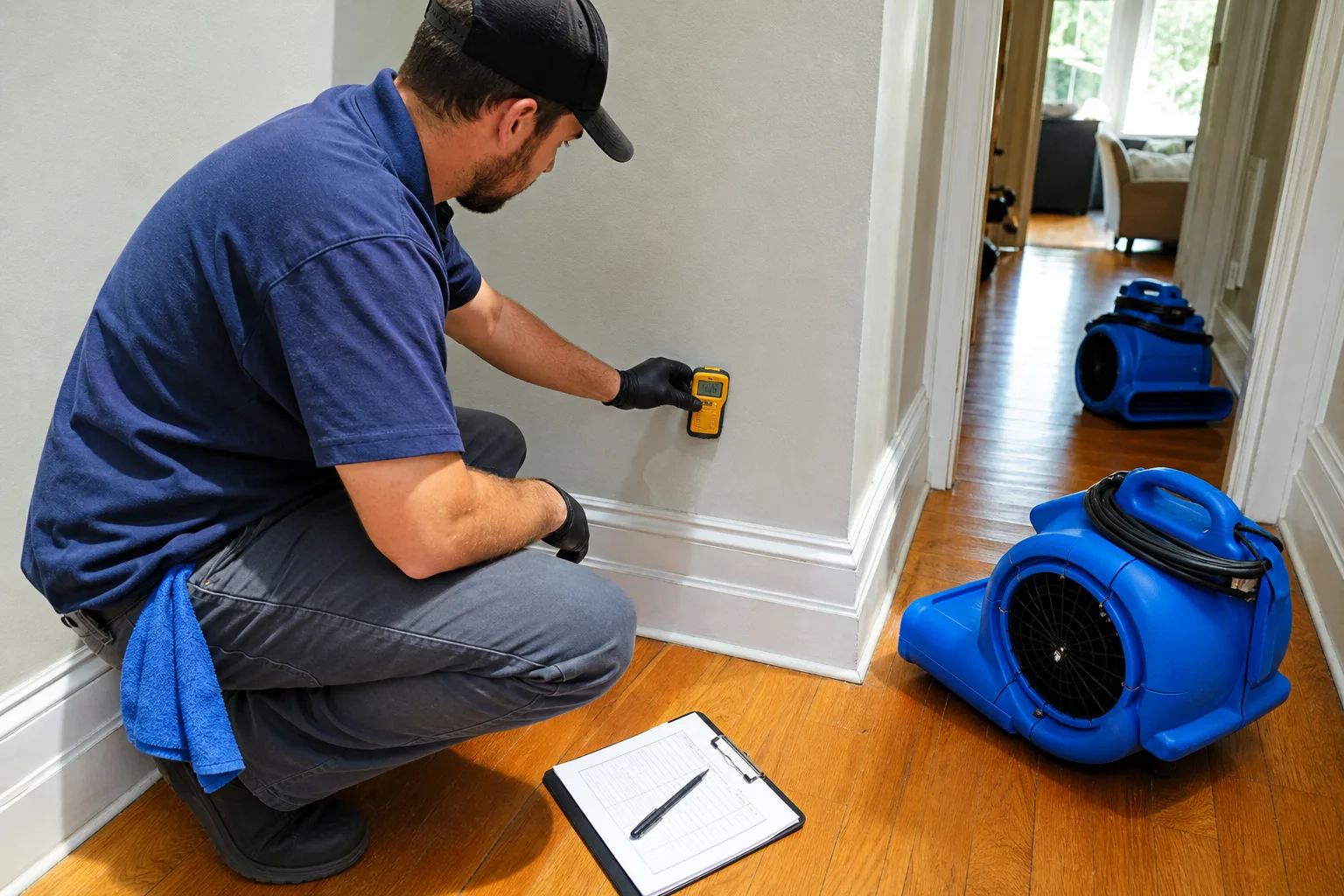
Walk past a house four days after a supply line let go and you can usually tell which kind of job is happening inside. One has three fans running in a hallway and a technician who last visited on the morning they were set. The other has a man with a clipboard and a pin meter crouched at the base of a wall, writing numbers into the same columns he wrote in yesterday, and the day before. The equipment looks nearly identical from the curb. What separates the two is whether anyone is reading the building while the air movers do their work.
The trade dried by hand long before it dried by number
For most of the twentieth century, drying a wet building was a judgment call made with the back of a hand and a nose. You pulled the carpet, you ran whatever fans the shop owned, you opened windows if the weather allowed, and you came back when the floor felt dry underfoot. That worked more often than you might think, because houses were built of materials that breathed, plaster over lath and solid lumber, and because nobody expected the job to finish on a schedule. The limitation was invisible rather than obvious. A wall could feel dry on its face and hold water in the cavity for weeks.
Two things changed that. Construction changed first: paper-faced gypsum board, vinyl wall coverings, engineered flooring over foam underlayment, and sealed envelopes that no longer let a damp cavity vent itself to the outdoors. Then the instruments arrived and got cheap. A moisture meter that once sat in a laboratory ended up on a van seat, and once a technician could put a number on a stud instead of an opinion, the opinion stopped being defensible. Insurance adjusters learned to ask for the number. Attorneys learned to ask for it later.
The result is a trade that now splits cleanly down the middle on a single question: does the job end when the schedule says so, or when the readings say so. Both approaches use fans, dehumidifiers and heat. Both leave a house that feels dry to a homeowner standing in a doorway. Only one produces a record showing that the framing, the subfloor and the bottom plate came back to the same moisture content as unaffected material in the same house. The Environmental Protection Agency is the federal body whose remit covers indoor mold and moisture, and its concern has always been the cavity rather than the surface.
What the ordinary week looks like on each route
A fast dry is usually a three-visit job. Day one, extract, pull wet carpet pad, set a handful of air movers and a dehumidifier, take one or two readings if the crew carries meters at all. Day three or four, somebody comes to collect the equipment, puts a hand on the baseboard, and calls it. Day five, the invoice. The attraction is real and should not be dismissed. The house is back in use quickly, the equipment turns over to the next loss, and the bill is smaller because drying is priced in equipment-days and labor visits, both of which just got cut.
The proper dry runs the same first day and then diverges. Somebody returns every single day, usually in the morning, and that visit takes twenty to forty minutes rather than five. They record the temperature and relative humidity of the affected space, the same two figures for an unaffected room and for the outdoors, the grain depth or specific humidity coming off the dehumidifier, and meter readings from the same marked points on the same materials. Marked points matter. If you read a different spot each day, you have a collection of numbers rather than a trend.
What they do with that reading is the actual work. If the drywall at a marked point has dropped two points since yesterday, the setup is working and nothing changes. If it has dropped nothing, something is wrong, and the technician has to decide whether the air is saturated, whether the air movers are pointed into a dead corner, whether there is a vapor barrier in the way, or whether there is more water behind the wall than anyone found on day one. That daily decision is the difference between drying a building and storing fans in it.
Where the two routes genuinely cost you differently
On a clean, shallow loss, caught in hours, on a slab floor with tile and no cavity involvement, the fast route and the proper route often converge. The water never got anywhere it could hide. Three days of equipment dries it, the readings would have confirmed what the hand already knew, and paying for five daily visits buys you documentation and little else. An honest contractor will say so. The spread opens as soon as water crosses a threshold into something layered: a wall cavity, a subfloor assembly, insulation, cabinet toe-kicks, or a stair stringer.
In those assemblies the surface dries first and fastest, because that is the face the fans are blowing on, and it dries while the core is still holding water. Pull the equipment at that moment and the building does something predictable. Moisture redistributes outward from the core over the following days, the surface comes back up, and nothing visible happens for three or four weeks. Then a baseboard cups, or a seam telegraphs through paint, or somebody notices the smell in a closet. The repair you paid for has to come out so the drying you skipped can happen, and the second round costs more than the first because now there is finish work to demolish.
There is an insurance dimension too, and it is worth knowing before the first fan goes down. A carrier paying for mitigation generally wants to see that the drying was justified day by day, which is exactly what the log provides. A job dried fast with no readings can be harder to defend when the bill arrives, and a secondary problem that surfaces six weeks later is much harder to tie back to the original loss without a record of where the moisture was and when. The clipboard is not bureaucracy. It is the only evidence that exists.
What a first-year apprentice learns, and what only shows up later
In year one, a good shop teaches the mechanical half, and teaches it properly. How to extract until the wand stops pulling water rather than until the carpet looks flat. How to space air movers so the airflow actually sweeps a surface instead of colliding with itself in a corner. How to set a dehumidifier where it can draw and discharge without short-cycling its own exhaust. How to use a pin meter and a non-invasive meter and know which one is lying in which situation. How to mark reading points with tape so tomorrow's number means something. All of that is teachable in weeks and checkable on a job.
What takes years is the reading of a building as a system. Knowing that a 1962 ranch with a crawlspace behaves nothing like a 2006 townhouse with a sealed envelope, and that the second one will hold water in the exterior wall long after the first has given it up. Knowing that a hardwood floor over plywood can be chasing a target for ten days and still be worth saving, while a laminate over foam was finished the moment it swelled. Knowing when to cut and when to leave it closed. That judgment comes from having been wrong and having had to come back.
Which gives you a practical way to hire. Ask who will be on site each day, and whether the same person will take the readings on day four who set the equipment on day one. Ask to see the log, and ask what the target moisture content is and where the unaffected comparison reading is being taken. Ask what would make them extend the job and what would make them end it early, because a technician who can answer both is working from measurement rather than habit. Shops that dry properly tend to answer those questions easily, because they answer them internally every morning anyway.
The fast dry is not a scam and the slow dry is not a virtue. They are two different bets about where the water went, and the only thing that settles the bet is a meter at a marked point, read on consecutive days by somebody who knows what the trend should look like. Ask for the readings before the equipment arrives, not after it leaves, and the choice stops being a matter of trust.