Your Fall Checklist Is Ten Years Old. Which Items Your Town Now Decides for You
Seasonal home maintenance has shifted from calendar dates to triggers, sensors and local ordinances, and the schedule people actually keep looks different because of it.
| Published | Section | Homes | |
|---|---|---|---|
| Author | Sebastian Kowalczyk | Reading time | 4 min |
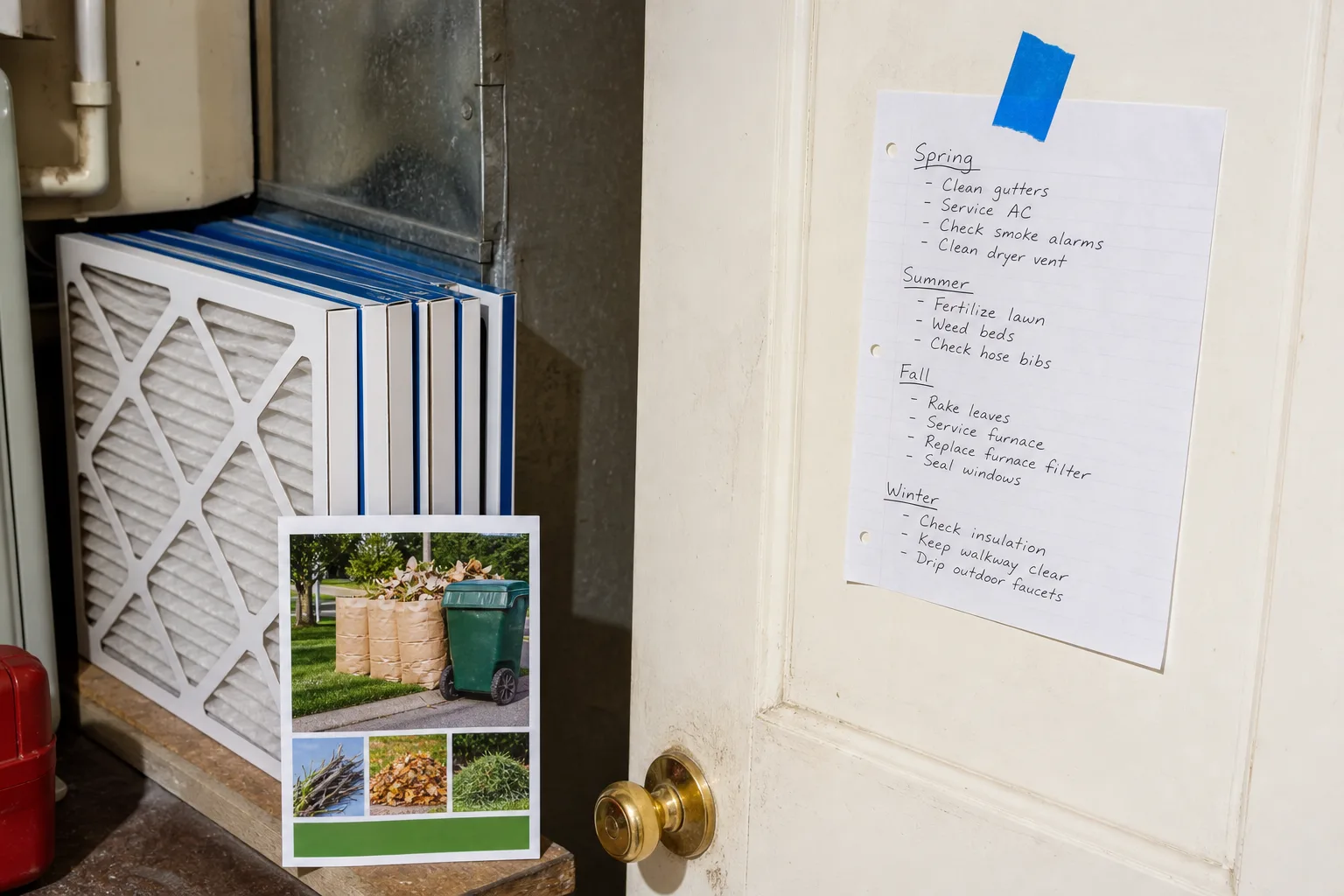
The seasonal maintenance list that circulated ten years ago was built on dates. Change the filter on the first of the month, service the furnace before Halloween, clean the gutters after the last leaf falls, drain the hose bibs before the first hard freeze. It was a good list, and most of it still holds, but almost nobody kept it for more than two years running. The failure was rarely discipline. The list assumed every house wears out on the same calendar, and it assumed nothing outside the house would tell you when a task came due.
The old schedule ran on dates, the one people keep runs on triggers
A date-based list has one structural weakness: it gives you no way to tell a task you skipped from a task you did not need. Miss the September furnace appointment and the house still heats, so the next September the appointment feels optional. A trigger-based schedule attaches each job to something you cannot help noticing. The filter changes when the thermostat reports its runtime climbing, not on the first Sunday. The gutters get cleared after the second heavy rain that overflows the corner by the front step. Same tasks, different anchor, and the anchor is what survives a busy month.
The diagnostic gain matters more than the convenience. When a job is tied to a symptom, you find out whether the symptom actually responds. Clearing a gutter every October is a reasonable habit; clearing it four times a season because it keeps overflowing is a grading and downspout problem being treated at the wrong end. Ten years ago that distinction lived in a contractor's head. Now the household notices it, because the trigger fires often enough to be annoying, and annoyance is the cheapest diagnostic instrument anyone owns.
What the equipment reports now, and which tests still cost money
Connected thermostats, condensate float switches, leak pucks under the water heater and washer, and utility usage graphs have replaced a fair amount of guesswork. Runtime data will show a heating system working longer for the same indoor temperature well before anyone feels cold, and a water meter with hourly reads will catch a running toilet or a slab leak in a way a quarterly bill never did. None of that diagnoses a cause. It narrows where to point a paid test, which is the whole point of owning it.
Some tests are still worth their fee and were worth it a decade ago too. A combustion analysis on a gas furnace, a static pressure reading across the air handler, a blower door and duct leakage test before you spend on insulation, a camera run down a sewer lateral on a house with mature trees. Those produce numbers a technician can act on. The tests I would not pay for twice are the ones that only confirm what a sensor already told you, and the ones offered free as an inspection whose real product is a quote.
The equipment side has changed underneath all of this. The Department of Energy oversees federal efficiency standards for residential heating and cooling equipment, and systems installed in the last several years behave differently from what they replaced. Variable-speed blowers and multi-stage compressors run longer at lower output, which means filters load up on a different curve and a dirty coil shows up as a comfort complaint rather than a hard failure. A filter interval copied from a single-stage furnace bought in 2011 is usually wrong on a 2023 system, in either direction.
The portion of the schedule your town writes for you
This is where a national checklist stops being useful. Yard waste collection is the plain example: some municipalities run loose-leaf vacuum trucks on a published route for three weeks in November, others take paper bags year-round, and others ended curbside collection entirely and moved to a drop-off site with a resident sticker. Your leaf work is scheduled by whichever of those applies, and the schedule changed in many places over the last decade without a letter to anyone. The rule sits in the public works page and the annual mailer nobody opens.
Several other tasks became legally timed rather than merely advisable. Sidewalk snow clearing is often written as a number of hours after snowfall ends, with a fine attached, which turns shovel readiness into a genuine deadline. Backflow preventers on irrigation systems require an annual test filed with the water utility in many districts, and the filing date, not your convenience, sets the appointment. Septic systems in some counties need documented pumping or an inspection at point of sale. Open burning of brush is permitted in one township and banned in the next.
Same house, different climate, different order of operations
Regional physics reorders the list before any ordinance does. In freeze-thaw country the controlling event is the first hard freeze, so hose bibs, irrigation blowouts, attic ventilation and ice dam prevention move to the front, and the diagnosis behind an ice dam is almost always attic heat loss rather than gutter design. On the Gulf and lower Atlantic the controlling variable is humidity and storm season: coil cleaning, condensate line flushing, dehumidifier maintenance, and a crawlspace that has to be checked in August rather than October.
In the arid West the same house needs a different calendar again. Evaporative coolers, hard-water scale on fixtures and water heaters, defensible space clearance around the structure, and irrigation efficiency under seasonal watering restrictions that set which days you can run a zone at all. A checklist that puts gutter cleaning first in Phoenix is a checklist written in Ohio. Getting the order right for your own climate, and then attaching each job to a trigger you will actually see, is most of what separates a schedule that runs for five years from one that lapses in March.
Write your version down once, with the local rules and their deadlines beside the tasks, and keep it where the filters are stored. The reason the current generation of schedules holds is not that anyone became more organized. It is that the house, the meter and the municipal calendar now do a share of the remembering, and the household only has to decide what to do about it.