Dried in Three Days or Dried Properly? What the Daily Moisture Log Settles
Fast drying and correct drying are not opposites, but they are decided by different evidence, and the daily meter readings are where the difference shows.
| Published | Section | Homes | |
|---|---|---|---|
| Author | Sebastian Kowalczyk | Reading time | 5 min |
A drying job is one of the few repairs where you can watch the diagnosis happen, if anyone will show you the numbers. The equipment arrives, the readings are taken, and from then on the whole question is whether a set of materials is losing water at the rate someone predicted. Speed is not the enemy. A house dried in four days by a crew that measured every morning is in better shape than one dried in nine by a crew that dropped fans and left. The distinction is not duration. It is whether the target was set from evidence.
How restoration drying became a stopwatch business
For a long stretch, drying a wet building meant opening it up and waiting on weather. Crews pulled baseboards, cut out plaster and wet insulation, and let the season do the work, which meant a January flood in a cold climate dried on a different schedule than a July one. Two changes reordered that. Low grain refrigerant dehumidifiers and, later, desiccant units made indoor conditions something a technician could set rather than accept. Small high velocity air movers made evaporation a matter of placement. Together they turned drying from a passive process into a controlled one, and anything controlled eventually gets measured.
What got measured, though, was partly chosen by who was paying. Insurers reimburse equipment by the day and the unit, and adjusters track how long a claim stays open, so the number of drying days became a line item with a spotlight on it. That pressure did real good. It ended the habit of leaving twenty fans running for two weeks because nobody had checked. It also created an incentive to declare completion early, which is why the industry built documentation standards, daily readings, defined dry goals, and a written scope, around a process that a stopwatch alone would have corrupted.
What a proper dry standard actually is, and why it is local
The target is not a number off a chart. A technician establishes what the same material reads in an unaffected part of the same building, the far end of the hallway, an upstairs closet, a subfloor two rooms away, and that reading becomes the goal for the wet area. This matters because a plaster wall in a coastal cottage in August and an oak floor in a dry inland winter sit at genuinely different equilibrium points, and treating either as wet or dry by a universal figure produces the wrong call. A house has its own baseline. Finding it is the first test worth paying for.
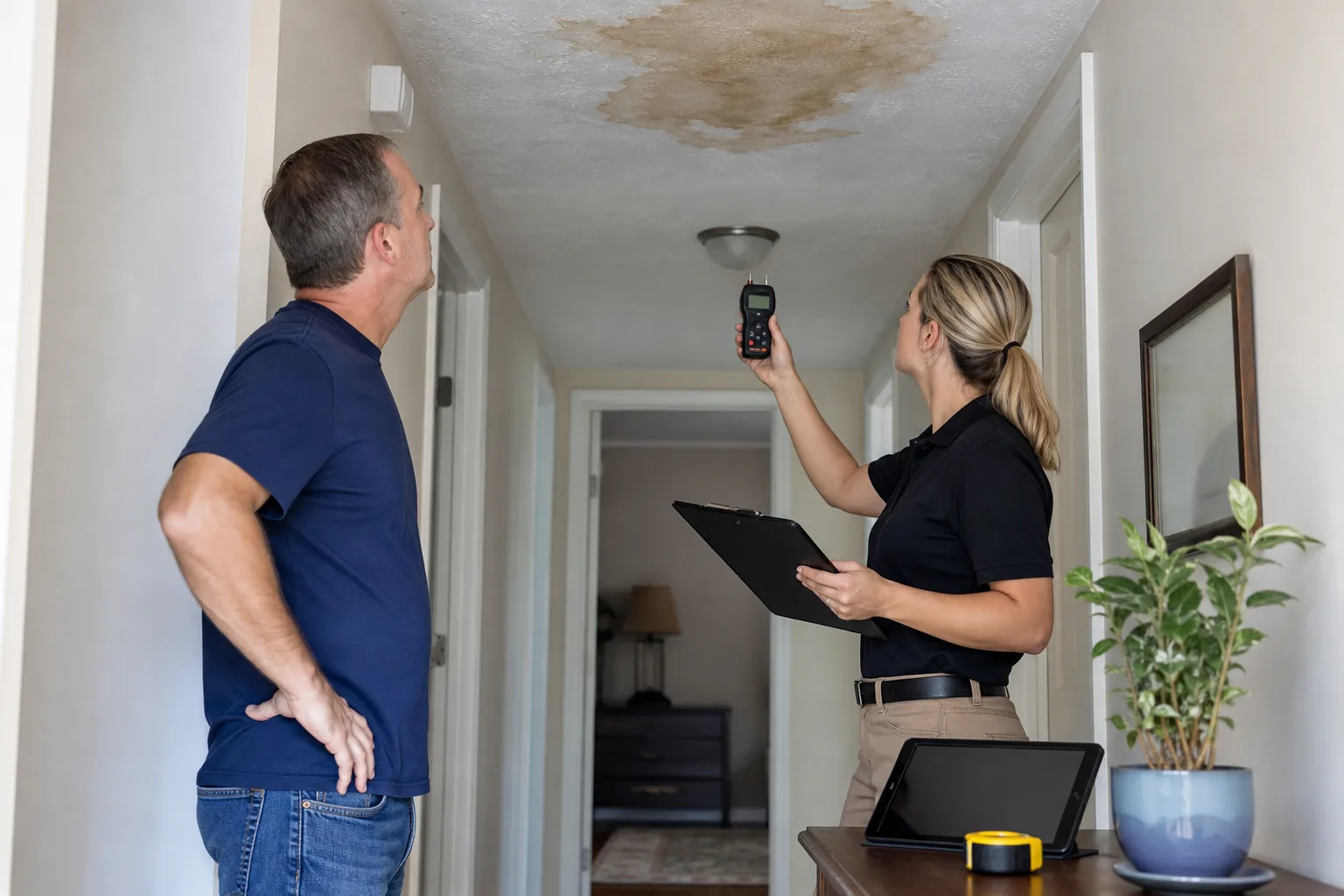
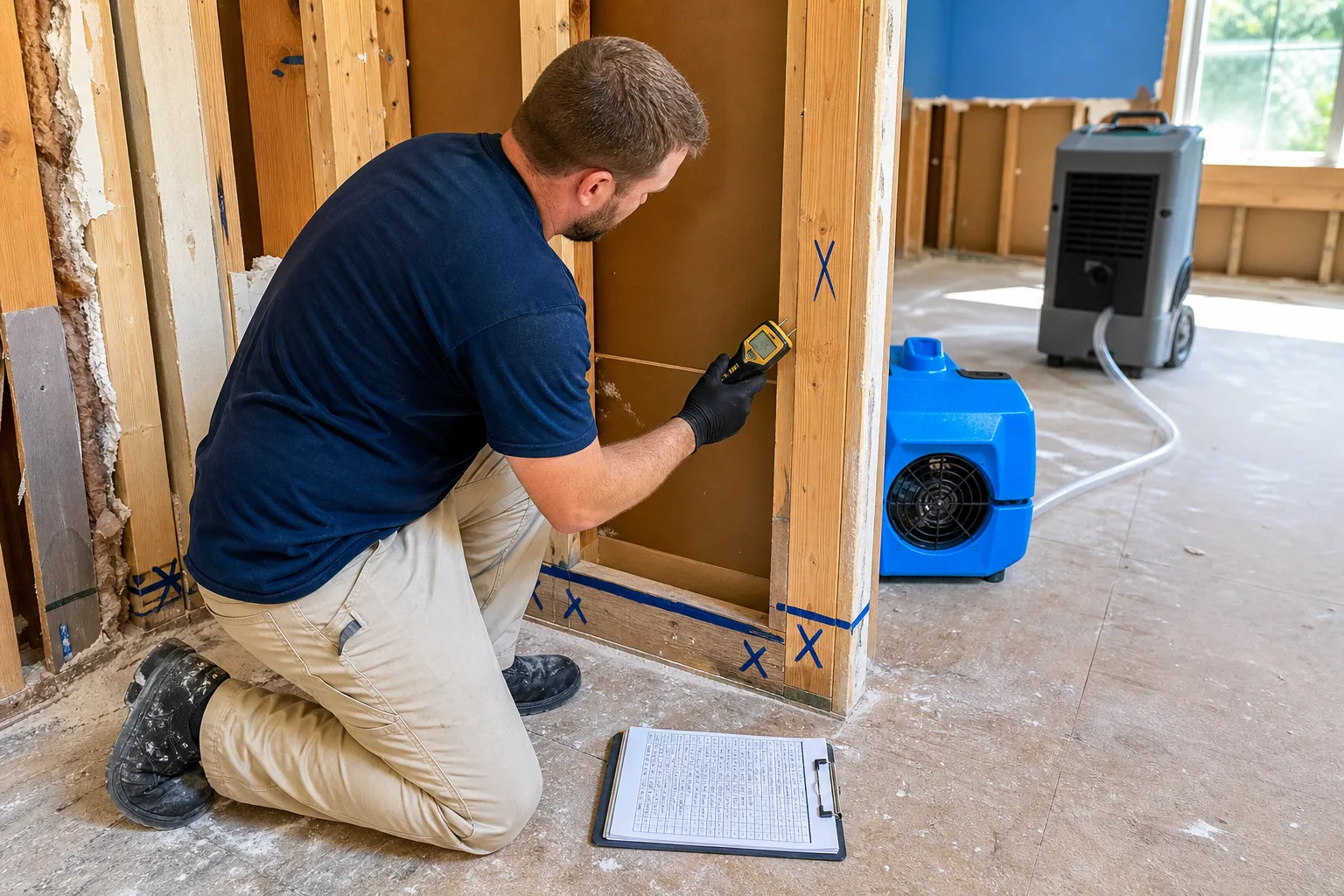
The instruments split the job in two. A pin meter reads moisture at a known depth in wood and can be driven into a joist or a sill plate to find whether water traveled below what you can see. A non invasive meter scans a surface without holes and is useful for mapping, for finding where the wet area stops, but it reads a zone rather than a point and can be fooled by foil backing, wire mesh or a wet duct behind the plane. A thermal camera finds temperature differences, not water, which makes it a pointer, not proof.
The ordinary week, hour by hour
Day one is loud and looks aggressive: extraction, controlled demolition where materials will not dry in place, insulation bagged out, equipment set and a chamber built with plastic to shrink the space being conditioned. Day two is when the crew learns whether their plan was right, because the numbers should have moved. Day three and four are the ones the homeowner finds hardest, since nothing visible changes, the fans keep running, and readings drop by small increments that mean everything to the technician and nothing to the eye. That flat stretch is normal, and it is exactly where an unmonitored job gets abandoned.
The log is the artifact that separates the two approaches. Each visit should record the temperature and relative humidity of the affected area, the outside air, the dehumidifier's exhaust, and the moisture content of each mapped material at the same marked spots. Same spots, same meter, same depth. A reading taken eighteen inches to the left is a new data point, not a comparison. When those columns march down steadily and reach the unaffected baseline, the job is documented as finished. When one material stalls while everything around it dries, you have found a cause nobody addressed.
That stall is the most useful thing a log produces. A subfloor that will not come down usually has water under it in a cavity that air movers never reach, or a supply line still weeping a small amount, or wet insulation left in a wall because the cut looked expensive on day one. Treating it with more fans treats the symptom. Opening an inspection hole, drilling the toe kick, pulling a section of baseboard, or setting an injection system to push dry air into the cavity treats the cause, and it usually costs less than three more days of equipment.
Where fast is legitimate, and where fast is a story
Genuinely fast drying comes from three things: getting wet material out early rather than negotiating with it, shrinking the conditioned space so the dehumidifier is not drying the whole house, and matching equipment to the material, which is why hardwood floors get mats and a wall cavity gets injection rather than a fan pointed at the room. None of that is a shortcut. It is engineering the evaporation instead of hoping for it, and a crew that works this way often finishes early and can prove it.
The version to watch for is the job that ends because the surface feels dry and the schedule says so. Drywall paper can read acceptably while the gypsum core behind it holds water, a hardwood surface can pass a hand test with the subfloor beneath still saturated, and a room can smell fine in week one and sour in week three. The Environmental Protection Agency is the federal body responsible for guidance on indoor moisture and mold, and its central point is unglamorous: it is water left in materials, not the visible damage, that decides what grows later.
So the questions to ask are narrow. What did you establish as the dry standard, and from which unaffected material? May I see today's readings against yesterday's, at the same marked points? Which materials are you drying in place, and what is the plan if one of them stalls? A crew that answers those in plain terms is running a diagnosis. A crew that answers with the number of days remaining is running a clock.
Ask for the log at the start, not at the end. The request costs nothing, it changes how carefully the first readings get taken, and it leaves you holding the one document that shows the house was dry when the equipment left.