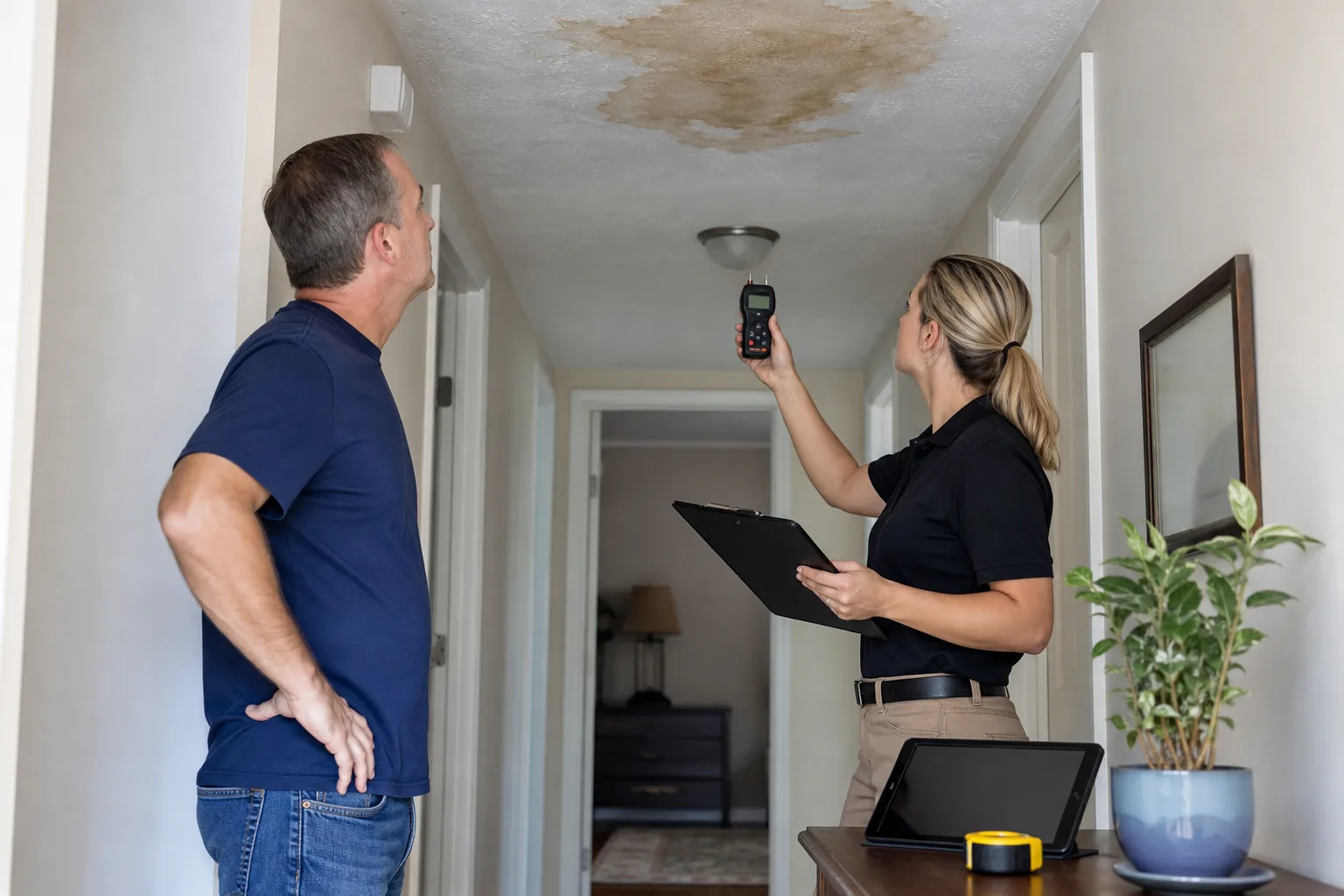
A Dishwasher Line Let Go for Ninety Minutes. What You Notice Nine Months Later
A small kitchen leak that gets mopped up in an hour still writes its consequences into the cabinets, the floor and the door casing, months after everyone stops thinking about it.
| Published | Section | Homes | |
|---|---|---|---|
| Author | Malcolm Greenhalgh | Reading time | 6 min |
The braided supply line behind a dishwasher gives up at the crimp, usually while nobody is home, and the machine keeps calling for water because the machine has no idea. Ninety minutes is a common number by the time somebody walks in, hears it, and shuts the stop valve under the sink. The visible water is maybe a gallon spread thin across the kitchen floor, and it mops up in twenty minutes with towels and a fan. Everyone agrees they caught it early. That is the moment the next nine months are decided, and almost nobody present understands that at the time.
The gallon you mopped was the smallest part of it
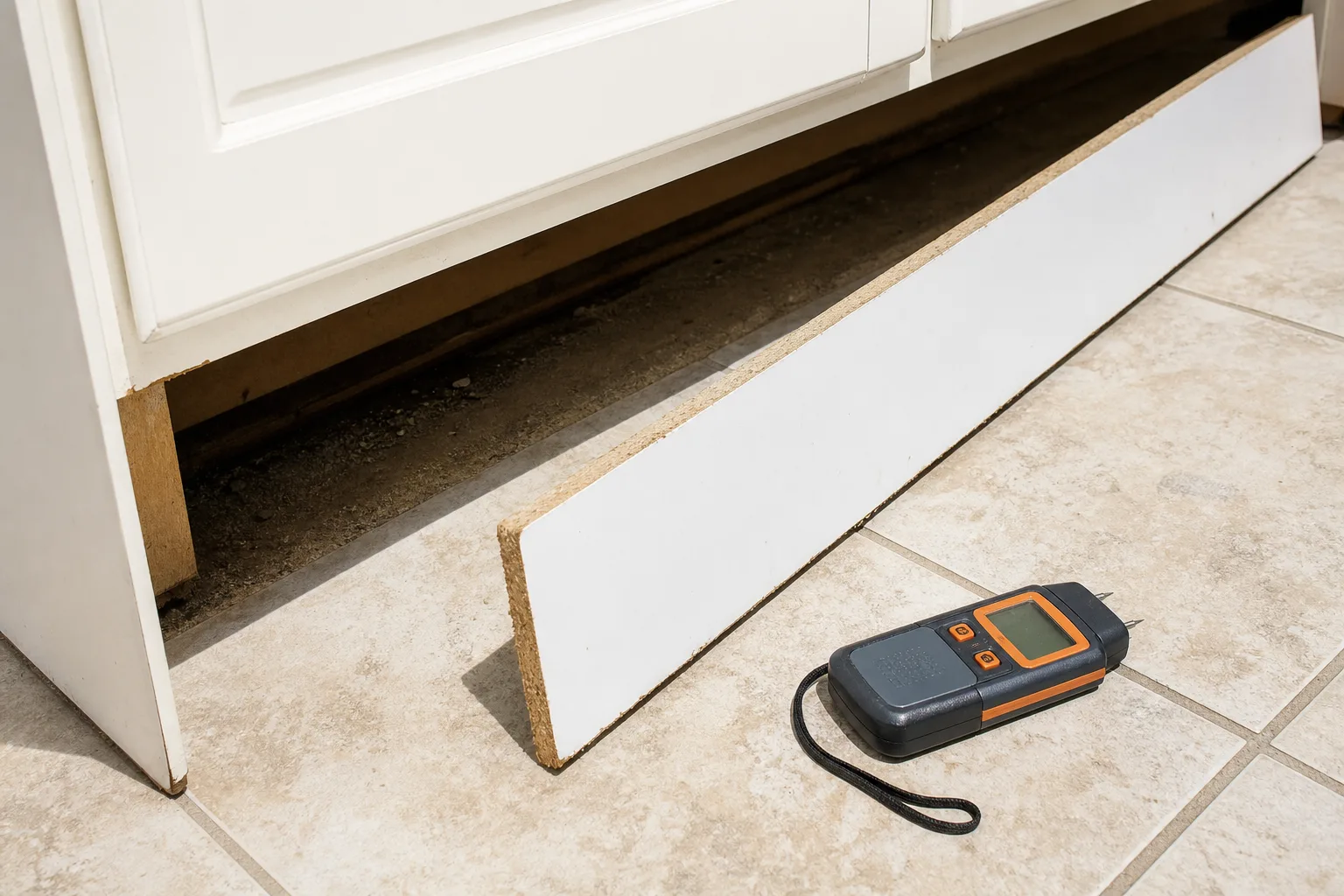
Water under a dishwasher does not sit in the open. It runs into the void behind the toe kick, which on a standard base cabinet is a sealed-off cavity four inches deep and running the full length of the run, and it travels sideways under three or four cabinets before it finds anywhere to stop. Particleboard cabinet bottoms wick it upward at the back edge, where nobody looks. Some of it reaches the wall plate, the bottom framing member of the wall, and follows it. If there is a heat register in the floor nearby, some of it goes down the boot. None of that shows on the surface you dried.
The floor covering decides where the rest goes. Sheet vinyl and glued luxury vinyl plank hold water against the subfloor rather than letting it evaporate, which is why a kitchen that looks bone dry on top can be carrying real moisture underneath for weeks. Floating plank floors let water travel along the underlayment to a doorway and stop there. Engineered wood takes it into the seams. The visible mop-up is honest work, but it addresses the one part of the event that was never going to cause a problem, and it produces a confidence that is entirely unearned.
What the household notices, and what it blames instead
The first sign is usually a cabinet door that stops closing flush, six or eight weeks out. The gable of a particleboard cabinet swells at the base, the box goes very slightly out of square, and the door hits at the top corner. People adjust the hinge, which works for a while. Then the finished end panel on the run develops a soft, blistered look at the bottom two inches, and the toe kick trim bows outward just enough to catch a vacuum head. Nobody connects any of this to a dishwasher line that failed in the spring, because the kitchen never looked wet.
Then there is the smell. It is not dramatic, and it is strongest when the sink base door has been closed all night, which means it is easy to write off as garbage or a trap that needs running. What it actually is, most of the time, is the underside of a cabinet bottom that has been sitting at high moisture content in a dark unventilated box since spring. The Environmental Protection Agency is the federal body responsible for guidance on indoor moisture and mold growth, and the reason its material keeps returning to the first day or two is that the window for keeping this from becoming a biological problem rather than a plumbing one is genuinely that short.
The one people find hardest to believe is the door. A hollow-core interior door on the far side of the kitchen wall starts to bind at the latch side, and it binds seasonally, worse in humid weather. That is the bottom plate of the wall having taken on moisture, swelling a fraction, and lifting the jamb out of plumb by an amount too small to see and large enough to feel in your hand every day. A carpenter will plane the door edge and the problem goes away. It is a real fix for a symptom whose cause sat under the cabinets nine months earlier.
What a first-year apprentice is taught to do in those forty-eight hours
Year one in a restoration shop is mostly instrumentation and documentation, and it is taught in that order for a reason. An apprentice learns to take a moisture reading in an unaffected part of the same material, in the same house, on the same day, and to write it down as the dry standard, because a number off a meter means nothing without something to compare it to. They learn to pull the toe kick rather than reason about it, to drill inspection holes in cabinet gables low and out of sight, to check the wall cavity with a probe instead of a pinless meter, and to photograph everything before anything moves. They learn that a thermal camera shows temperature difference, not water, and that every reading it suggests has to be confirmed with a meter.
They also learn the physical work: setting air movers so they push along a surface rather than at it, sizing a dehumidifier to the cubic footage of the space rather than to what is on the truck, and containing the drying area with plastic so the machine is working on the kitchen rather than on the whole first floor. Then daily readings, on a sheet, in the same locations, until the affected materials come back to the dry standard and stay there. That is a defined, teachable procedure, and a well-trained first-year worker can carry it out on a small kitchen loss competently.
The parts that only come with the years
What does not come in year one is knowing where the water went before anyone opens anything, and that judgment is worth more on a job this size than any single piece of equipment. Someone who has done a few hundred of these walks in, looks at the direction of the floor joists, the location of the register, whether the run has a lazy Susan, and whether the base cabinets are face-frame or frameless, and they know within a minute or two which three cabinets need to come apart and which four do not. They know that a particleboard bottom which has been saturated does not recover its structure even after the meter reads dry, so drying it in place is a decision to replace it later at full cabinet-run pricing.
The other thing experience buys is the timing call, which is really a cost call. There is a version of this job that takes two days, three machines and a replaced cabinet bottom, and a version that takes three weeks, a demolished cabinet run, a floor and a drywall repair, and the only difference between them is who was standing in the kitchen on the first morning. A seasoned technician is comfortable saying that a wall does not need opening, which is a harder thing to say than the opposite and rests entirely on having been wrong about it before.
How to tell which one is at your door
Ask what the dry standard is and where they took it, and ask to see the daily log rather than a summary at the end. Ask whether the toe kick is coming off and, if the answer is no, why not, because the reasoning in that answer tells you almost everything about the training behind it. A firm that sends a second-year technician alone to a kitchen loss and a firm that sends one with a supervisor for the first assessment are running two different businesses, and the second one is the one you want for a job where the whole outcome is set in two days.
Ninety minutes of water is a small event handled properly and an expensive one handled by eye. The difference is not equipment, and it is not urgency. It is somebody who was taught to measure before deciding, and who has since done it often enough to know where to look first.