Arranging a Funeral in Winter? The Order the First Week Has to Happen In
A first-timer's sequence for the first week after a death, including the price disclosures federal rules require and the scheduling that cold weather and holiday closures change.
| Published | Section | Family | |
|---|---|---|---|
| Author | Malcolm Greenhalgh | Reading time | 4 min |
The first week after a death runs on a sequence that does not care how you feel about it, and the sequence is partly set by law, partly by the cemetery, and partly by whatever the calendar happens to be doing that week. Most people arranging a funeral have never done it before and will not do it again for years. That inexperience is normal and the trade is built to absorb it. What catches people out is not grief. It is the two or three decisions that get made early, under time pressure, in an order that quietly forecloses cheaper or better options later in the week.
Days one and two: pronouncement, transfer, and the signatures that unlock everything else
Nothing else in the week can move until a death is pronounced and certified, and the person who signs is not the funeral director. It is an attending physician, a hospice nurse under physician authority, or a medical examiner, depending on where and how the death happened. The funeral home files the paperwork, but it files what someone else signs. In winter this matters more than it sounds, because county vital records offices and clerk's windows close for federal holidays, and a burial or cremation permit issued electronically on a Tuesday can sit unissued over a four-day weekend. Ask on day one which office issues the permit and whether it is open.
Transfer of the body into the funeral home's care happens alongside this, often within hours, and that call is usually made before anyone has compared prices. That is fine and it is reversible. Authorizing transfer does not commit you to the rest of the arrangement, and a first conversation about moving someone from a hospital or a residence is not a contract for the funeral. Say plainly that you have not chosen a provider yet. Any competent firm has heard that sentence many times and will quote the transfer fee as a separate line.
The disclosures you are owed before you choose anything
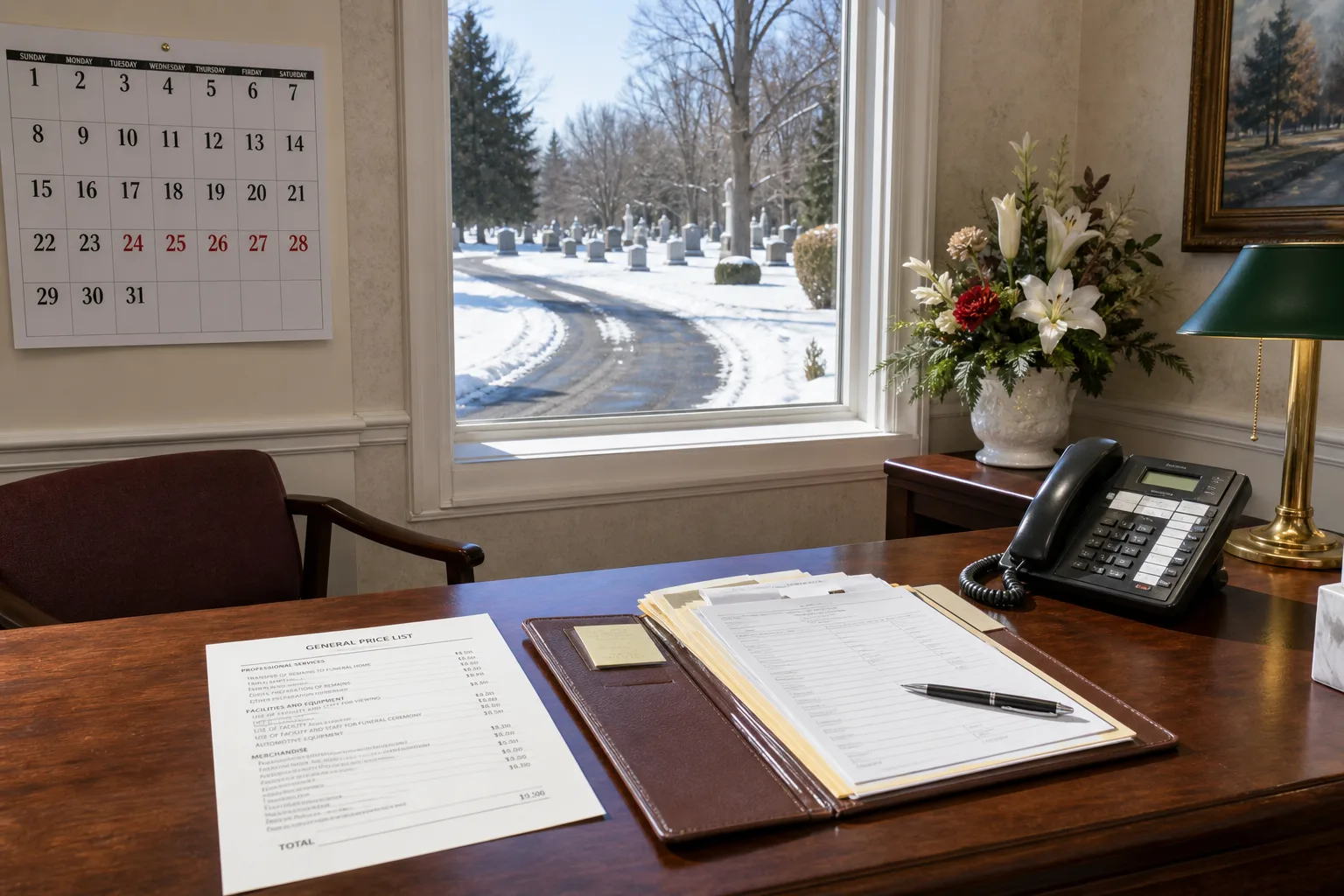
The Federal Trade Commission oversees the rule that governs how funeral goods and services are priced and presented to families, and the practical effect is simple: you are entitled to an itemized general price list, in writing, to keep, at the start of any in-person discussion of arrangements, and to prices over the telephone if you ask. You do not have to buy a package. You cannot be required to buy a casket for a cremation. If you supply a casket bought elsewhere, the funeral home must accept it without charging a handling fee, which is why families comparing affordable caskets from outside suppliers can do so without losing the services of the firm they have already chosen.
Reading that price list in order is the part first-timers skip. The basic services fee is nondeclinable and appears on every arrangement. Everything beneath it is optional and should be priced separately: embalming, which is rarely required by state law and usually a matter of whether there will be a public viewing, refrigeration, use of facilities, the hearse, the printed material. Take the list home for an hour if you can. A second reading at a kitchen table reliably finds two or three lines nobody would have chosen deliberately.
What the season moves, and how early you have to know
Cold weather changes the schedule more than it changes the cost. Some cemeteries in northern states limit or delay in-ground interment when the frost line is deep, holding the casket in a receiving vault until spring, which is a normal arrangement with its own fee and its own paperwork. Grave opening crews often do not work weekends or holidays without a surcharge, and in December and January that surcharge is easier to trigger than families expect. Crematories run on a queue, and a holiday week compresses several days of intake into fewer operating days. Ask about the queue on day two, not day five.
Clergy, musicians, and the people who travel are the other seasonal constraint, and they are the one families underweight. A church with four services already scheduled in a holiday week has less room than it does in March. Out-of-state relatives face flights that are both expensive and full. Setting the service date a few days later than instinct suggests is not a delay, it is scheduling, and almost every element of the week, from the obituary deadline to the catering count, keys off that single date once it is fixed.
Year one of the trade, and what only time teaches
An apprentice in a funeral home spends the first year learning what is procedural: transfer, preparation, filing deaths with the state, the mechanics of the price list, the vocabulary of vault and liner and committal. Those things are teachable in months and are examined before licensure. What takes years is the judgment about sequence, knowing on a Wednesday afternoon in late December that the permit office closes Friday, the crematory is three days out, and the cemetery crew will not open a grave on the holiday, and saying so before the family picks a date. When you interview a funeral home, that is the capability worth testing, and the test is simple. Describe your week and listen for whether they volunteer the constraints you had not thought of.
The order holds in any season: certify, transfer, read the itemized list, fix the date against the real constraints, then buy. First-timers who follow it spend less and redo nothing.