An Adjuster Is Coming Wednesday. Five Things to Settle Before the Scope Is Written
The scope an adjuster writes sets your household's schedule for months, decides who honors the repair guarantee, and quietly determines how often money arrives.
| Published | Section | Homes | |
|---|---|---|---|
| Author | Adaeze Nwachukwu | Reading time | 5 min |
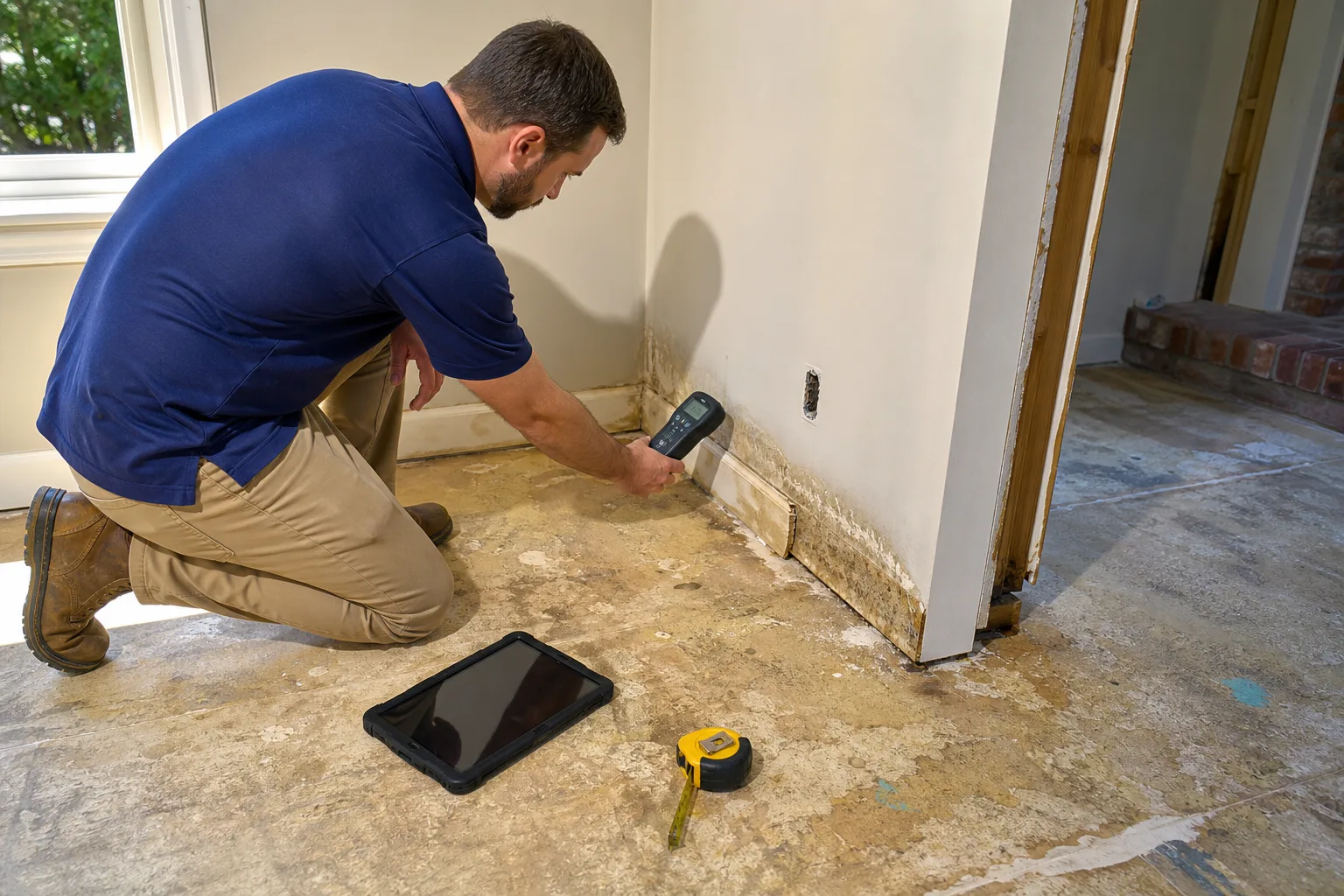
The visit itself takes ninety minutes. A man in boots walks the rooms with a moisture meter and a laser measure, photographs the ceiling stain from four angles, asks when you first noticed the smell, and leaves. What he writes afterward, the scope, becomes the document your household lives inside for the next three or four months: which weeks you have a kitchen, which contractor answers the phone, when money lands, and who is still standing behind the drywall repair in year three. Almost nobody traces the later friction back to that morning.
Who the adjuster answers to, and what he can approve in the room
There are three people who might show up and they are not interchangeable. A staff adjuster is an employee of your carrier. An independent adjuster is a contractor the carrier hires by the file, often in volume after a storm, and may be handling two hundred claims across three counties. A public adjuster works for you, for a percentage, and is licensed by your state. Ask which one you have, and ask the second question that matters more: what dollar figure can you approve without sending this up for review?
That number sets your calendar. An adjuster with authority to approve twenty thousand can settle a bathroom on the spot; one who must route everything through a desk examiner adds a week to every change order, and changes are the rule, not the exception, once a wall is opened. Get the name of the desk examiner, the claim number, and a direct extension rather than the general queue. When the independent adjuster's assignment ends, and it will end, that extension is the only thing that survives the handoff.
The scope is a schedule, not just a price
Adjusters write scopes in estimating software that prices each line by unit: square feet of drywall, linear feet of baseboard, cabinet removal and reset. The total gets the attention. The line items decide how your week runs. A scope that pays to detach and reset your kitchen cabinets means a two-day job. A scope that pays to replace them means eight weeks of lead time on a cabinet order, a temporary sink in the laundry room, and a family eating off a card table through Thanksgiving. Same house, same water, very different November.
So read the scope as an itinerary. Ask for the full line-item estimate, not the summary page, and go through it against the rooms with a tape measure in hand. Look for what is missing rather than what is priced low: the toe kicks, the shoe molding, the paint that must run wall to corner rather than stopping at the wet line, the second coat, the final cleaning. Missing lines are the cheapest thing in the world to add in week one and the most contested thing to add in week nine.
Who honors the guarantee when the managed-repair contractor is gone
Many carriers will offer a preferred or managed-repair contractor, and the pitch is real: the work is coordinated, the invoices go straight to the carrier, and the repair typically carries a workmanship guarantee that the carrier stands behind for a stated term. Read that term. Ask how many years, ask what it covers besides labor, and ask the question the brochure does not answer: if this firm closes or leaves the program, who performs the warranty repair, and does the carrier assign a replacement or does the obligation simply end with the company?
The answers differ by carrier and by state, and they are worth getting in writing before anyone lifts a hammer. A five-year workmanship guarantee that the carrier will reassign is a genuinely valuable thing, better than what most independent contractors offer on their own paper. A guarantee that dies with the vendor is worth what the vendor's phone number is worth in year four. Either way, keep the signed guarantee, the contractor's license number, and the manufacturer warranties for the flooring and the roofing in one folder with the claim number written on it.
The contents inventory nobody warns you about
The structural claim is the adjuster's work. The contents claim is largely yours, and it arrives as homework: an itemized list of what was damaged, with age, original cost, brand, and where possible a receipt or a photograph. For a flooded basement that is not a form, it is a project, forty or eighty or three hundred lines, built in the evenings after work while a dehumidifier runs. Households routinely under-claim by thousands simply because the list got tiring around item sixty and the rest went unrecorded.
Do it in passes rather than in one sitting. Photograph everything before it goes to the curb, including labels and serial plates, because the depreciation applied to a mid-grade item and a premium one is not the same. Ask the adjuster which software the carrier accepts for the inventory, whether a spreadsheet is fine, and how they handle items you cannot document. Ask also how the recoverable depreciation is released, since on a replacement cost policy the second check usually requires proof that you actually bought the replacement.
Payment cadence, and the money you are spending in the meantime
Week to week, the real strain is timing. Your mortgage servicer may be named on the building check and may hold the funds in escrow, releasing them in draws after inspections, which means your contractor waits and your schedule slips. Meanwhile you are paying out of pocket for a hotel, a rental, restaurant meals, laundry, and a storage unit, all of which may be covered under additional living expenses but only against receipts and only above what you normally spend. Ask at the first visit how ALE is reimbursed and on what cycle.
Then ask about an advance. Most carriers will issue one early, and a few thousand dollars in the first week buys clothes, a crib, and a month of the storage unit without a credit card balance building behind it. Keep receipts in one envelope and log the days you were out of the house. If the loss involves flooding, the National Flood Insurance Program is administered by FEMA and runs on its own rules and its own proof-of-loss deadlines, separate from the homeowners policy, so establish early which policy is paying which part.
None of this requires an adversarial posture. Most adjusters are managing more files than they would like and will tell you plainly what they can and cannot approve if you ask in the room rather than in a letter six weeks later. Write down the answers, dated, with the name of the person who gave them. That single habit, more than any argument about square footage, is what turns a claim into something that closes cleanly and stays closed.